






















The best pickleball balls
Four pickleball balls compared — the two most familiar outdoor tournament balls and two softer indoor balls — plus how to pick the right one for your courts.
As an Amazon Associate I earn from qualifying purchases. When you buy through links on this page, we may earn a commission at no extra cost to you. Learn more
Pickleball balls look interchangeable, but the ball you play with changes the game more than most players expect. Outdoor balls are harder, heavier and have smaller holes so they cut through wind; indoor balls are softer and lighter with larger holes, so they bounce and grip better on gym floors. Using the wrong type leads to wild bounces, slow rallies or balls that crack within a session.
Within each type, balls differ in speed, bounce, how true they fly and how long they last before cracking or going out of round. The good news is that a few well-established balls dominate clubs, leagues and tournaments, and they are easy to buy in multipacks. We compared the most widely used options and explain which one fits the way and the place you play.
Our top picks
-
1
 Illustration
Best overall
Franklin X-40 Outdoor Pickleballs
Outdoor games, leagues and tournaments
UseOutdoorHoles40ApprovalUSA Pickleball approved -
2
 Illustration
Best for fast play
Onix Dura Fast 40 Outdoor Pickleballs
Competitive players who like a quick, hard ball
UseOutdoorHoles40ApprovalUSA Pickleball approved -
3
 Illustration
Best indoor
Onix Fuse Indoor Pickleballs
Gym floors and indoor courts
UseIndoorHoles26ApprovalUSA Pickleball approved -
4
 Illustration
Best indoor alternative
Franklin X-26 Indoor Pickleballs
Indoor players who also use the X-40 outdoors
UseIndoorHoles26ApprovalUSA Pickleball approved
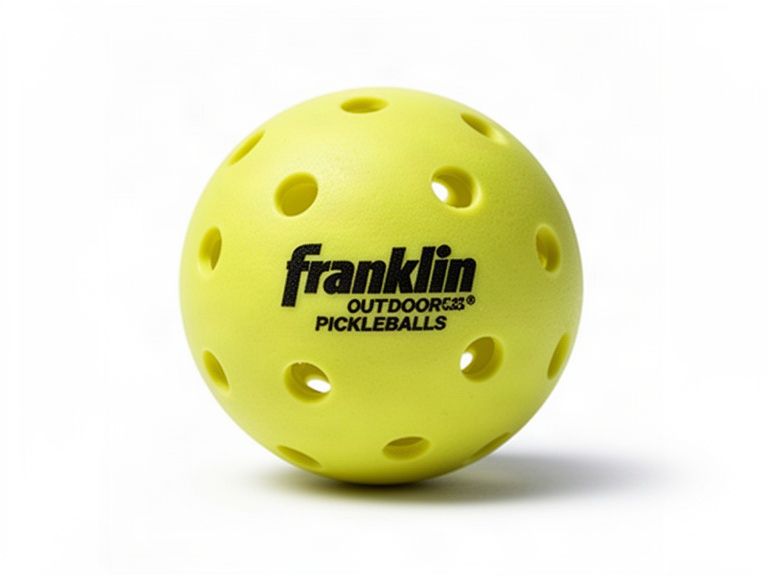
Franklin X-40 Outdoor Pickleballs
Illustration
A one-piece, 40-hole outdoor ball that is among the most widely used in competitive play.
Best for: Outdoor games, leagues and tournaments- Use
- Outdoor
- Holes
- 40
- Approval
- USA Pickleball approved
- Construction
- One-piece, seamless
What we like
- Familiar feel used at many major events
- Seamless construction helps it fly true
- Consistent bounce from ball to ball
- Widely available in multipacks and several colors
Keep in mind
- Hard shell can still crack in cold weather
- Too fast and hard for indoor courts
- Feels firmer off the paddle than softer balls
The Franklin X-40 has become one of the most familiar outdoor balls in pickleball, used at many major tournaments and stocked by countless clubs. That alone makes it a smart default: if you practice with the X-40, you are practicing with the ball many events use.
Its one-piece, seamless construction is designed to keep the ball round and its flight consistent, and players generally find the bounce predictable from one ball to the next. The 40-hole pattern handles breezy outdoor conditions well.
No hard outdoor ball is immune to cracking, and the X-40 is no exception in cold weather or after long sessions on rough courts. Keep a few fresh balls in the bag and rotate them in regularly.
Bottom line: A dependable all-round choice for outdoor play, from casual games to tournaments.
Onix Dura Fast 40 Outdoor Pickleballs
Illustration
A long-running tournament ball known for its hard shell and fast pace.
Best for: Competitive players who like a quick, hard ball- Use
- Outdoor
- Holes
- 40
- Approval
- USA Pickleball approved
- Feel
- Hard and fast
What we like
- Fast, lively pace rewards aggressive play
- Long tournament history, so many players know it well
- Flies steadily in wind
- Widely sold in multipacks
Keep in mind
- Prone to cracking, especially in cold weather
- Hard shell is less forgiving for beginners
- Fast pace shortens rallies
For years the Dura Fast 40 was the ball at many of the biggest outdoor tournaments, and it is still a favorite among competitive players who like a fast, hard ball. The firm shell comes off the paddle quickly, rewarding drives and put-aways, and the 40-hole pattern keeps it steady in breezy conditions.
That speed is also why some recreational players find it less fun. Rallies are shorter, mishits are punished, and the hard shell is more prone to cracking than some newer designs — particularly on cold days or rough courts.
If your league or local tournaments use it, practice with it. Otherwise, a slightly more forgiving ball such as the Franklin X-40 suits most mixed-level groups better.
Bottom line: A quick, familiar tournament ball for competitive players who like pace.
Onix Fuse Indoor Pickleballs
Illustration
A softer 26-hole indoor ball designed for consistent bounce on gym floors.
Best for: Gym floors and indoor courts- Use
- Indoor
- Holes
- 26
- Approval
- USA Pickleball approved
- Feel
- Softer, lighter
What we like
- Softer shell grips indoor floors for controlled rallies
- Larger holes slow the ball for longer points
- Consistent bounce on wood and sport-court floors
- Available in several colors
Keep in mind
- Floats and blows around outdoors
- Softer shell can dent or lose shape over time
- Slower pace takes adjusting to for outdoor players
Indoor pickleball needs a different ball, and the Onix Fuse Indoor is one of the most established choices. Its softer shell and 26 larger holes slow the ball down and help it grip smooth gym floors, which produces longer, more controlled rallies than an outdoor ball would.
The bounce is consistent on wood and sport-court surfaces, and the softer feel is easier on newer players who are still learning to control pace.
Do not take it outside. In wind it floats and drifts, and on rough outdoor surfaces the softer plastic wears quickly. For indoor leagues, rec centers and school gyms, though, it is a dependable choice.
Bottom line: A dependable, controlled ball for indoor courts and gym floors.
Franklin X-26 Indoor Pickleballs
Illustration
Franklin’s 26-hole indoor ball, a natural partner for groups that play the X-40 outside.
Best for: Indoor players who also use the X-40 outdoors- Use
- Indoor
- Holes
- 26
- Approval
- USA Pickleball approved
- Feel
- Lighter indoor ball
What we like
- Larger holes and lighter weight suit indoor courts
- Familiar brand for players who use the X-40 outdoors
- Sold in multipacks and several colors
- Predictable bounce on smooth floors
Keep in mind
- Not suited to outdoor play
- Can soften or lose shape with heavy use
- Some indoor venues standardize on other balls
The Franklin X-26 is the indoor counterpart to the popular X-40, which makes it an easy choice for clubs and players who move between outdoor courts in summer and gyms in winter. It uses a lighter build with 26 larger holes, so it slows down and bounces predictably on smooth indoor floors.
Compared with the Onix Fuse, the differences are subtle and mostly a matter of feel and what your venue uses. Many players simply pick whichever ball their indoor league plays.
Like any indoor ball, it is not designed for outdoor use, and heavy play can gradually soften it or knock it out of round. Rotate balls regularly and retire any that wobble in flight.
Bottom line: A solid indoor ball, especially for groups already using Franklin outdoors.
Side-by-side comparison
| Product | Use | Holes | Approval | Construction | Score |
|---|---|---|---|---|---|
| Franklin X-40 Outdoor PickleballsBest overall | Outdoor | 40 | USA Pickleball approved | One-piece, seamless | 9.2 |
| Onix Dura Fast 40 Outdoor PickleballsBest for fast play | Outdoor | 40 | USA Pickleball approved | — | 8.8 |
| Onix Fuse Indoor PickleballsBest indoor | Indoor | 26 | USA Pickleball approved | — | 8.6 |
| Franklin X-26 Indoor PickleballsBest indoor alternative | Indoor | 26 | USA Pickleball approved | — | 8.4 |
Specifications are from manufacturer listings at the time of writing and can change between production runs.
Outdoor versus indoor balls
- Outdoor balls typically have about 40 smaller holes, a harder plastic shell and a little more weight. They fly faster, resist wind better and bounce lower on concrete and asphalt courts.
- Indoor balls typically have about 26 larger holes and a softer shell. They are lighter and slower, which suits smooth gym floors and indoor courts where there is no wind.
Using an outdoor ball indoors makes rallies fast and skiddy; using an indoor ball outdoors makes it float and blow around.
Some balls are sold as all-purpose or as softer recreational options. They can be a good compromise for casual groups that move between gyms and outdoor courts, but players who compete usually keep separate indoor and outdoor balls.
Speed, bounce and feel
Even among approved balls of the same type, some are harder and faster while others are a little softer and slower. Faster, harder balls reward drives and put-aways and shorten rallies. Softer balls are more forgiving, keep points going and suit mixed-level groups and newer players. Temperature changes this too: the same ball plays harder and faster on a hot day and stiffer on a cold one.
Approval matters for leagues and tournaments
USA Pickleball tests and approves balls for sanctioned play. If you play in leagues or tournaments, practice with the ball your events use so the speed and bounce feel familiar. For casual games, any approved ball of the right type will do.
Durability and cracking
Hard outdoor balls eventually crack, especially when played on rough surfaces or in cold weather, when the plastic becomes more brittle. Some balls are made in two halves joined at a seam, while others are molded in one piece; one-piece balls tend to fly truer for longer. Expect to rotate in new balls regularly if you play often — a cracked or egg-shaped ball bounces unpredictably and should be retired.
Color and visibility
Optic yellow is the most common color and is easy to see against blue and green courts. Orange, pink and white balls can stand out better against certain backgrounds or for players with particular vision needs. Choose a color that contrasts with your court surface and surroundings.
Buying and storing
Multipacks of 6, 12 or more are usually better value per ball and let you keep fresh balls in rotation. Store them at room temperature rather than in a hot car or freezing garage, and keep them in a mesh bag or box so they do not get crushed. On cold days, keep the game balls warm in a bag until you need them.
Frequently asked questions
Can I use outdoor pickleball balls indoors?
You can, but they are harder and faster than indoor balls and tend to skid and bounce low on gym floors. Indoor balls with larger holes give longer, more controlled rallies indoors.
Why do pickleball balls crack?
Repeated hard hits, rough court surfaces and cold temperatures all stress the plastic. Cold makes balls more brittle, so cracking is more common in winter. Replace cracked or out-of-round balls promptly.
How many holes should a pickleball ball have?
Outdoor balls usually have about 40 smaller holes and indoor balls about 26 larger holes. The hole pattern affects how the ball flies and how it handles wind.
What color pickleball is easiest to see?
Optic yellow is the most popular and easy to see on most courts. Choose a color that contrasts with your court and background; orange or pink can stand out better in some settings.
How long does a pickleball ball last?
It varies with temperature, surface and how hard people hit. Regular players often get a few games to a few sessions from an outdoor ball before it softens, cracks or goes out of round.
How we picked
We compared hole count, construction, intended surface, approval status and reported durability for the most widely used pickleball balls consistently available online, drawing on manufacturer information, governing-body approval lists and independent player feedback. Our picks and scores are based on this research — we have not tested these products hands-on. Brands cannot pay to be included. Read our full method.