






















The best two-player board games
Six games built for exactly two players compared — head-to-head strategy, quick card duels, a cooperative landing game and a board-free abstract.

As an Amazon Associate I earn from qualifying purchases. When you buy through links on this page, we may earn a commission at no extra cost to you. Learn more
Plenty of board games say "2–4 players" on the box, but many of them feel thin with only two. Games designed specifically for two are different: they are tuned so every move directly affects your opponent, games stay short enough for a weeknight, and the box usually fits on a coffee table.
That makes dedicated two-player games a great buy for couples, roommates and parents who play with one child. We picked six with different personalities — a compact civilization duel, a calm quilting puzzle, a quick trading card game, a classic tense card game, a cooperative game where you land a plane together and an abstract game with no board at all. We compared play time, publisher information on ages where it is consistent, rules complexity, how much luck is involved, how much table space each needs and whether the game is competitive or cooperative.
Our top picks
-
1
 Illustration
Best overall
7 Wonders Duel
Couples who want a deep, quick strategy game
Players2Play timeAbout 30 minutesTypeCard drafting, civilization building -
2
 Illustration
Best relaxed game
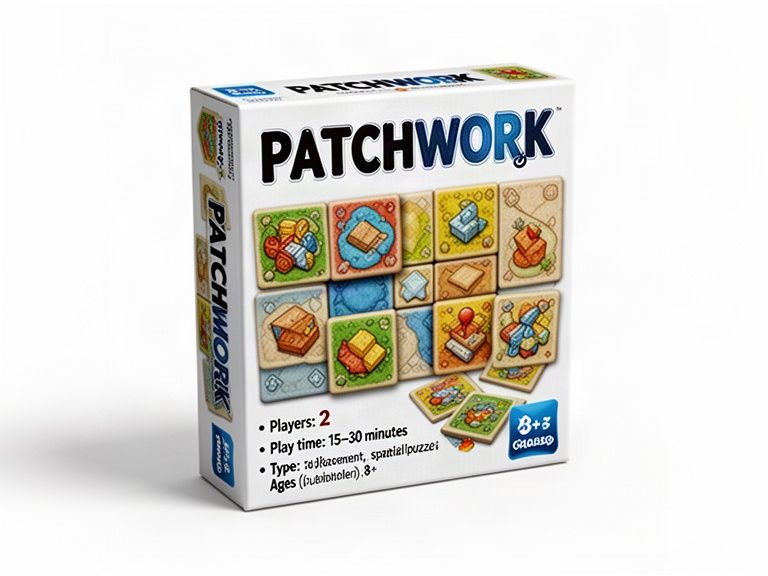
Patchwork
Calm evenings and puzzle lovers
Players2Play time15–30 minutesTypeTile placement, spatial puzzle -
3
 Illustration
Best quick card game
Jaipur
Players who like trading and push-your-luck
Players2Play timeAbout 30 minutesTypeSet collection, trading -
4
 Illustration
Best classic card duel
Lost Cities Card Game
Couples who like a little risk
Players2Play timeAbout 30 minutesTypeCard game, push your luck -
5
 Illustration
Best cooperative for two
Sky Team
Couples who would rather win together
Players2Play timeAbout 15–20 minutes per landingTypeCooperative dice placement -
6
 Illustration
Best abstract game
Hive
Chess-style thinkers and travelers
Players2Play timeAbout 20 minutesTypeAbstract strategy
7 Wonders Duel
Illustration
A two-player civilization game where players draft cards from a shared layout to build an ancient city.
Best for: Couples who want a deep, quick strategy game- Players
- 2
- Play time
- About 30 minutes
- Type
- Card drafting, civilization building
- Ages (publisher)
- 10+
What we like
- Three different ways to win keep both players alert
- Deep strategy in about half an hour
- Clever card layout means every pick opens options for your opponent
- Compact box
Keep in mind
- Many card symbols to learn at first
- Sudden military or science wins can feel abrupt
- Not ideal for very young players
7 Wonders Duel adapts the popular multiplayer 7 Wonders into a sharp game for two. Cards are laid out in overlapping patterns, and you can only take cards that are uncovered. Every card you take may reveal new cards for your opponent, so each pick is a small calculation of what you gain versus what you give away.
There are three routes to victory: score the most points at the end, push the military track all the way to your opponent's capital, or collect six different science symbols. That keeps both players watching each other closely, since an ignored threat can end the game early.
The symbols take a game or two to learn. Once they click, it packs the depth of a much longer game into about 30 minutes.
Bottom line: The best all-round two-player strategy game for couples and regular opponents.
Patchwork
Illustration
A tile-laying game where players buy fabric patches with buttons and fit them onto a personal quilt board.
Best for: Calm evenings and puzzle lovers- Players
- 2
- Play time
- 15–30 minutes
- Type
- Tile placement, spatial puzzle
- Ages (publisher)
- 8+
What we like
- Rules take minutes to explain
- Satisfying Tetris-like puzzle
- Low conflict and calm pace
- Fine for kids around 8 and up
Keep in mind
- Limited direct interaction
- Same core puzzle each game
- Time track can confuse first-timers
Patchwork turns quilting into a smart little puzzle. Patches of fabric are arranged in a circle, and on your turn you may buy one of the next three, paying in buttons and time. You fit the patch onto your personal quilt board, aiming to fill it as completely as possible, while some patches also earn buttons as income.
Time is the clever part. Each patch moves your marker along a shared time track, and whoever is behind takes the next turn — so sometimes one player gets several turns in a row. Balancing button income, time cost and board space gives the game real depth.
It is calm and friendly, with little direct conflict, which suits couples and parent-child games. The core puzzle stays the same game to game, but that is part of its relaxing appeal.
Bottom line: A cozy, clever puzzle game for two that is easy to teach and hard to put down.
Jaipur
Illustration
A fast trading card game in which two merchants collect and sell goods to become the Maharaja's trader.
Best for: Players who like trading and push-your-luck- Players
- 2
- Play time
- About 30 minutes
- Type
- Set collection, trading
What we like
- Quick to learn with tense decisions
- Best-of-three structure gives comebacks
- Camels add a clever twist
- Compact box travels well
Keep in mind
- Card draws can swing a round
- Publisher age guidance varies by edition and listing
- Tokens are small
Jaipur is a quick trading duel. Five cards sit in a shared market. On your turn you either take cards from the market — one good, several by swapping, or all the camels — or sell a set of matching goods for tokens. Earlier sales earn more, and bigger sets earn bonus tokens, so you are constantly deciding whether to sell now or hold out for a bigger payoff.
Camels are the clever twist. Taking them all fills your herd, which you can use for future swaps, but it also refreshes the market with new cards for your opponent. Those small trade-offs make every turn tense.
Games are played as best-of-three rounds, which gives a player who falls behind a chance to recover. Its quick rounds make it a favorite for short evenings and travel.
Bottom line: A fast, tense trading game for two that rewards timing and nerve.
Lost Cities Card Game
Illustration
A two-player card game where players fund expeditions to five lost cities, taking calculated risks on each one.
Best for: Couples who like a little risk- Players
- 2
- Play time
- About 30 minutes
- Type
- Card game, push your luck
- Ages (publisher)
- 10+
What we like
- Simple rules with real tension
- Investment cards add risk and reward
- Great for couples who play often
- Takes little table space
Keep in mind
- Scoring math can be fiddly
- Luck of the draw matters
- Theme is light
Lost Cities is a long-running two-player favorite. Players hold cards in five colors, each representing an expedition, and lay them in ascending order on their side of the board. Starting an expedition costs points, so you must play enough cards to make it profitable — and investment cards played first can double or triple the result, for better or worse.
The tension comes from what you discard. Anything you throw away goes to a shared pile your opponent can take, so dumping a card you don't need may hand them exactly what they want.
Scoring requires some arithmetic each round, so keep a pencil handy. For couples who want a quick, light card game with real risk-taking, it remains a classic.
Bottom line: A timeless, tense two-player card game that rewards calculated risks.
Sky Team
Illustration
A cooperative dice game in which two players act as pilot and co-pilot landing an airliner without talking about their dice.
Best for: Couples who would rather win together- Players
- 2
- Play time
- About 15–20 minutes per landing
- Type
- Cooperative dice placement
What we like
- Made for exactly two players working together
- No talking about dice creates real tension
- Many airports and challenges add replay value
- Short games invite another try
Keep in mind
- Not for players who want head-to-head competition
- Publisher age guidance varies by listing
- Early landings can feel unforgiving
Sky Team is a cooperative game built specifically for two. One player is the pilot and the other the co-pilot, and together you must land a passenger plane. Each round, both players roll dice secretly and take turns placing them on the cockpit board to control speed, axis, flaps, landing gear and radio — but you can't discuss your dice once the round begins.
That silent coordination is the game. You must read your partner's placements and trust that they understand your plan. Landings at harder airports add new challenges, so it keeps offering fresh goals.
It won the Spiel des Jahres in 2024, Germany's prestigious game-of-the-year award. Couples who prefer working together over competing will find it a refreshing change.
Bottom line: The best cooperative game made for exactly two players.
Hive
Illustration
An abstract strategy game with no board, in which players place and move insect tiles to surround the opposing queen bee.
Best for: Chess-style thinkers and travelers- Players
- 2
- Play time
- About 20 minutes
- Type
- Abstract strategy
What we like
- No board, so it plays on any flat surface
- Heavy, durable tiles
- Chess-like depth with simpler rules
- Pocket edition available for travel
Keep in mind
- Pure skill means a stronger player wins most games
- No theme beyond the insects
- Can feel dry for casual players
Hive is an abstract game in the tradition of chess, but with no board. Players take turns placing hexagonal insect tiles — ants, spiders, beetles, grasshoppers and a queen bee — and moving them around the growing hive. Each insect moves differently, and the goal is to completely surround your opponent's queen.
The rules fit on a short sheet, yet the strategy runs deep. Because the hive itself is the board, it can be played anywhere — on a café table, a train tray or the floor — and the thick tiles are built to last.
As with chess, the more experienced player usually wins, so it suits opponents of similar skill or anyone keen to improve. A pocket edition makes it an excellent travel game.
Bottom line: A board-free abstract strategy game with chess-like depth that goes anywhere.
Side-by-side comparison
| Product | Players | Play time | Type | Ages (publisher) | Score |
|---|---|---|---|---|---|
| 7 Wonders DuelBest overall | 2 | About 30 minutes | Card drafting, civilization building | 10+ | 9.4 |
| PatchworkBest relaxed game | 2 | 15–30 minutes | Tile placement, spatial puzzle | 8+ | 9.0 |
| JaipurBest quick card game | 2 | About 30 minutes | Set collection, trading | — | 8.9 |
| Lost Cities Card GameBest classic card duel | 2 | About 30 minutes | Card game, push your luck | 10+ | 8.6 |
| Sky TeamBest cooperative for two | 2 | About 15–20 minutes per landing | Cooperative dice placement | — | 9.1 |
| HiveBest abstract game | 2 | About 20 minutes | Abstract strategy | — | 8.7 |
Specifications are from manufacturer listings at the time of writing and can change between production runs.
Why buy a dedicated two-player game
Games built for two avoid the problems of multiplayer games played with a pair: no dead zones on the board, no rules that assume a third person, and no long waits. Every turn is a direct response to what your opponent just did, which keeps both players engaged. Many come in small boxes, so it is easy to keep a few on hand and rotate between a thinky game and a light one depending on the evening.
Competitive or cooperative?
Most two-player games are head-to-head, but cooperative two-player games are growing. If one partner dislikes losing to the other, a cooperative option like Sky Team lets you face the challenge together. Many couples keep one of each.
Luck versus skill
- Low luck (Hive, 7 Wonders Duel): the better player usually wins, which suits players of similar experience who like improving.
- Some luck (Jaipur, Lost Cities, Patchwork): a less experienced player has a real chance, which helps when skill levels differ, such as a parent and child.
If one player is much more experienced, a game with some luck keeps it fun for both. Another option is a handicap: the stronger player can give up a turn, a card or a few points at the start.
Length and table space
Two-player games often aim for 15–30 minutes, so you can fit in a rematch. Check the footprint too. Hive needs no board at all and plays on any flat surface; 7 Wonders Duel and Patchwork need a moderate amount of space.
Ages and teaching
Publisher age grades for these games usually sit around 8 to 14 and up, depending on the edition. Grades reflect rules complexity, so a patient younger player can often learn with help. Teach by playing an open-handed first game where you talk through your choices. Explain the goal first, then the turn structure, and save edge-case rules until they come up during play.
Care and travel
Small two-player games are ideal travel games. Keep cards in sleeves if you'll play on trains or picnic tables, and store tiles or tokens in small bags inside the box. Hive even comes in a pocket-size version designed for travel.
Frequently asked questions
What is the best two-player game for couples?
7 Wonders Duel and Patchwork are favorites for head-to-head play. If you prefer working together, Sky Team is a cooperative option made for exactly two.
Can these games be played with more than two people?
No. They are designed for exactly two players. If you sometimes have more people, look for games that list a wider player count.
Which is easiest to learn?
Patchwork, Jaipur and Lost Cities can each be taught in a few minutes. Hive is also simple to learn, though it rewards long practice.
Are two-player games good for parents and kids?
Yes, especially games with some luck, such as Patchwork or Lost Cities, which give younger or less experienced players a real chance to win.
How long do these games take?
Most finish in 15–30 minutes, which makes it easy to play best-of-three in a single evening.
How we picked
We compared play times, publisher age grades where they are consistent across editions, rules complexity, luck versus skill, table footprint and portability for well-established two-player games widely available online. Our picks and scores are based on this research — we have not tested these products hands-on. Brands cannot pay to be included. Read our full method.