






















The best party games for groups
Six party games compared — team word games, drawing games and guessing games that handle big groups and teach in a couple of minutes.
As an Amazon Associate I earn from qualifying purchases. When you buy through links on this page, we may earn a commission at no extra cost to you. Learn more
A party game has a different job from a regular board game. It has to work for six, eight or ten people, many of whom may not think of themselves as "game people." The rules need to be explained over the noise of a kitchen, new arrivals should be able to jump in, and the fun should come from the people at the table rather than from the pieces.
The games below all clear that bar. They lean on conversation, drawing, clue-giving and reading your friends, so the laughs come from the group itself. We compared publisher player counts and age grades, how long a game runs, whether players compete in teams or individually, and how well each game copes with late arrivals and mixed ages, then picked the right game for different kinds of gatherings — from family holidays to adults-only nights.
Our top picks
-
1
 Illustration
Best overall
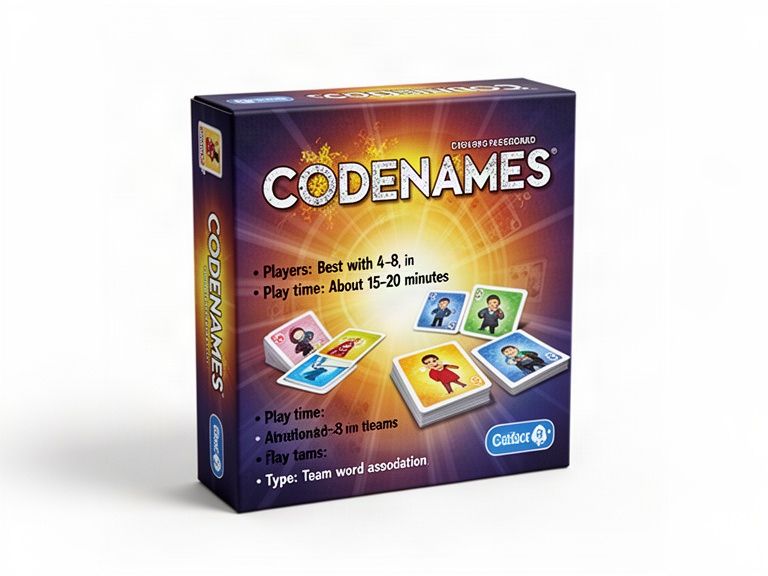
Codenames
Groups who enjoy clever wordplay
PlayersBest with 4–8, in two teamsPlay timeAbout 15–20 minutesTypeTeam word association -
2
 Illustration
Best for big groups
Wavelength
Larger groups of teens and adults
Players2–12Play time30–45 minutesTypeTeam guessing, social deduction -
3
 Illustration
Best drawing game
Telestrations 8-Player
Groups who say they cannot draw
Players4–8Play timeAbout 30 minutesTypeDrawing, telephone-style guessing -
4
 Illustration
Best cooperative party game
Just One
Family gatherings and mixed-age groups
Players3–7Play timeAbout 20 minutesTypeCooperative word guessing -
5
 Illustration
Best for casual players
Apples to Apples Party Box
Laid-back groups and family-friendly parties
Players4–10Play timeFlexible — play to a set scoreTypeJudging, word matching -
6
 Illustration
Best classic word game
Taboo
Fast-talking teens and adults
Players4 or more, in two teamsPlay timeFlexible — play to a set scoreTypeTimed team word guessing
Codenames
Illustration
A team word game in which spymasters give one-word clues to help teammates find their secret agents in a grid of words.
Best for: Groups who enjoy clever wordplay- Players
- Best with 4–8, in two teams
- Play time
- About 15–20 minutes
- Type
- Team word association
What we like
- Simple to explain, deep enough to replay endlessly
- Two teams absorb uneven or growing groups
- Lots of word cards for variety
- Clue-giving creates great table talk
Keep in mind
- Spymaster role can stress shy players
- Slow if a clue-giver overthinks
- Needs a table everyone can see
Codenames is one of the most widely loved party games of the last decade. Twenty-five word cards are laid out in a grid. Two spymasters, one per team, know which words belong to their team and try to steer teammates with a single word and a number — "Ocean, 2" might point to Fish and Wave. Guess an opposing agent and you help the other team; hit the assassin and you lose instantly.
The rules take a minute, but the game rewards creativity and table talk, which is why it works for everyone from family holidays to adult game nights. Two teams make it easy to fit uneven numbers or late arrivals.
Being spymaster can be stressful for people who freeze under pressure; let volunteers take that role. Recent editions differ slightly in listed player count and age grade, so check the box if kids will play.
Bottom line: The best all-round party game for groups who like words, debate and clever clues.
Wavelength
Illustration
A team guessing game where a clue-giver hints at a hidden point on a spectrum and teammates turn a dial to find it.
Best for: Larger groups of teens and adults- Players
- 2–12
- Play time
- 30–45 minutes
- Type
- Team guessing, social deduction
- Ages (publisher)
- 14+
What we like
- Debates over the dial are the best part
- Handles up to a dozen players
- Chunky dial device is fun to use
- Works with people who don't play board games
Keep in mind
- Bulky box
- Publisher age grade is 14 and up
- Some spectrum cards are subjective by design
Wavelength is built around one great idea. A card shows a spectrum, such as "Hot to Cold" or "Overrated to Underrated." The clue-giver secretly sees where a target sits on that spectrum and gives a single clue — "Hot chocolate," say. Their team then argues about where that clue falls and turns the dial to match.
The arguments are the game. Teams debate whether a movie is "a little overrated" or "very overrated," and those discussions reveal how differently friends think. It handles a wide range of player counts, and people who never play board games pick it up instantly.
The box is large because of the dial device, and the publisher grades it for ages 14 and up. Some cards are deliberately subjective, so groups that hate ambiguity may find it frustrating.
Bottom line: A lively guessing game that turns a big group into a friendly debate club.
Telestrations 8-Player
Illustration
A drawing-and-guessing game based on the telephone game, where sketches and guesses pass around the table.
Best for: Groups who say they cannot draw- Players
- 4–8
- Play time
- About 30 minutes
- Type
- Drawing, telephone-style guessing
- Ages (publisher)
- 12+
What we like
- Bad drawings make it funnier, not worse
- Everyone plays at the same time
- Reveal at the end of each round is reliably hilarious
- Dry-erase sketchbooks for each player
Keep in mind
- Strict upper limit of eight in this version
- Markers dry out over time
- Scoring is optional and often ignored
Telestrations combines drawing and guessing with the old telephone game. Each player secretly draws a word in a small dry-erase sketchbook, then passes it on. The next person guesses what the drawing shows, the next draws that guess, and so on. At the end, everyone reveals how "cowboy" turned into "a sad potato."
Because everyone draws and guesses at the same time, there is no waiting around, and drawing skill doesn't matter — poor sketches usually make the results funnier. It works especially well with groups who would never sit down for a strategy game.
This version handles four to eight players; a separate party pack covers larger groups. Keep spare dry-erase markers on hand, as the included ones eventually dry out.
Bottom line: The most reliably funny party game for groups who want to laugh rather than compete.
Just One
Illustration
A cooperative word game where players write one-word clues to help a teammate guess a mystery word, but duplicate clues are canceled.
Best for: Family gatherings and mixed-age groups- Players
- 3–7
- Play time
- About 20 minutes
- Type
- Cooperative word guessing
- Ages (publisher)
- 8+
What we like
- Whole group works together, so nobody loses
- Publisher age grade of 8 and up suits families
- Teaches in under a minute
- Easel stands make clues easy to read
Keep in mind
- Tops out at seven players
- Dry-erase markers need replacing over time
- Very competitive groups may miss head-to-head play
Just One is the friendliest game on this list. One player looks away while everyone else sees a mystery word. Each of them writes a one-word clue on a small easel — but before the guesser sees the clues, any duplicates are removed. Write the obvious clue and you might cancel out someone else's.
That small twist creates a lot of fun, as players try to be helpful without being too obvious. The whole group plays as a team against the deck, aiming for the best score, so it works for family gatherings where some people get upset about losing.
It handles three to seven players, which covers most family groups, and the rules can be explained in one breath. Competitive groups may prefer a team-versus-team game.
Bottom line: A warm, cooperative word game that works for families and casual players alike.
Apples to Apples Party Box
Illustration
A comparison card game in which players match noun cards to a judge's adjective card, and the judge picks a favorite.
Best for: Laid-back groups and family-friendly parties- Players
- 4–10
- Play time
- Flexible — play to a set score
- Type
- Judging, word matching
What we like
- Simple enough for anyone to play immediately
- Rotating judge keeps everyone involved
- Family-friendly card content
- Easy to stop at any time
Keep in mind
- Winning depends on the judge's taste
- Can feel repetitive in long sessions
- Less clever than modern word games
Apples to Apples is the friendly ancestor of many judging-style party games. Each round, a rotating judge flips an adjective card such as "Fuzzy" or "Dramatic." Everyone else plays a noun card from their hand that they think fits — or that the judge will find funny — and the judge picks a winner.
There is almost nothing to learn, which makes it ideal for parties where many guests rarely play games. Reading the judge's personality becomes the real strategy: a literal-minded grandparent and a sarcastic teenager reward very different answers.
It is less clever than Codenames or Wavelength, and long sessions can feel samey. For relaxed, family-friendly parties with a wide age range, though, it remains an easy choice.
Bottom line: An easy, family-friendly judging game for groups who want to chat more than strategize.
Taboo
Illustration
A timed team game where you get teammates to say a word without using the forbidden words listed on the card.
Best for: Fast-talking teens and adults- Players
- 4 or more, in two teams
- Play time
- Flexible — play to a set score
- Type
- Timed team word guessing
- Ages (publisher)
- 13+
What we like
- Timer creates frantic, funny moments
- Scales to large groups by adding people to teams
- Familiar to many players already
- Buzzer adds energy
Keep in mind
- Buzzer can be noisy in small spaces
- Quick-talkers dominate
- Publisher grade of 13 and up limits it for younger kids
Taboo is a classic for a reason. A player draws a card showing a target word and a list of forbidden words they cannot say — describe "Pizza" without saying cheese, slice, pepperoni or Italian. Their team races the timer to guess as many cards as possible, while an opponent watches with the buzzer for slips.
It is fast and loud, and the pressure of the timer makes people say ridiculous things. Teams can be any size, so it handles larger groups and late arrivals without fuss.
Confident, quick speakers tend to dominate, so make sure the clue-giver role rotates. The buzzer is part of the fun, but it can be a lot in an apartment late at night.
Bottom line: A loud, fast classic for teams of teens and adults who like quick thinking.
Side-by-side comparison
| Product | Players | Play time | Type | Ages (publisher) | Score |
|---|---|---|---|---|---|
| CodenamesBest overall | Best with 4–8, in two teams | About 15–20 minutes | Team word association | — | 9.4 |
| WavelengthBest for big groups | 2–12 | 30–45 minutes | Team guessing, social deduction | 14+ | 9.1 |
| Telestrations 8-PlayerBest drawing game | 4–8 | About 30 minutes | Drawing, telephone-style guessing | 12+ | 8.9 |
| Just OneBest cooperative party game | 3–7 | About 20 minutes | Cooperative word guessing | 8+ | 8.8 |
| Apples to Apples Party BoxBest for casual players | 4–10 | Flexible — play to a set score | Judging, word matching | — | 8.4 |
| TabooBest classic word game | 4 or more, in two teams | Flexible — play to a set score | Timed team word guessing | 13+ | 8.3 |
Specifications are from manufacturer listings at the time of writing and can change between production runs.
Team games versus everyone-for-themselves
Team games like Codenames, Wavelength and Taboo split the group into two sides. They handle large and uneven groups well, let shy players contribute without being in the spotlight, and keep scoring simple.
Individual or all-together games like Telestrations, Apples to Apples and Just One give everyone a personal turn. They create more individual moments but have a firmer upper limit on players.
If your group size changes from week to week, a team game is the safer buy.
Match the game to the crowd
- Family gatherings with kids: choose picture or simple word games with publisher age grades around 8 and up, such as Just One.
- Mixed adults who don't usually play games: drawing and guessing games with little reading, like Telestrations.
- Friends who like a bit of thinking: Codenames and Wavelength reward clever clues and debate.
Check the publisher's age grade if children will play; some party games include references or words aimed at teens and adults.
Rules that teach in two minutes
At a party, nobody wants to read a rulebook. The best games can be explained in a sentence or two — "give a one-word clue that links your team's words" — and learned by playing the first round. Avoid games with heavy setup or complex scoring for large groups.
Space, noise and visibility
Make sure everyone can see the shared components. Codenames needs a table that everyone can lean over; Telestrations needs each person to have a lap or table space to draw. For very large groups, team games where only the clue-giver needs to see the cards are easier.
Replay value
Party games depend on fresh content. Look at how many cards or word prompts are in the box, and whether expansions or alternate versions exist. Most of the picks below have plenty of content for many parties, and several sell expansion packs or spin-offs.
Keep it inclusive
Rotate clue-givers so everyone gets a turn, let people pass if they're uncomfortable, and avoid shaming bad guesses — it's the fastest way to make reluctant players sit out the next game. If guests speak different first languages, picture and drawing games are usually fairer than fast word games.
Frequently asked questions
What party game works for the largest group?
Team games scale best. Wavelength is listed for up to 12 players, and Codenames and Taboo can stretch to larger groups by adding people to each team.
Which party games are good for families with kids?
Just One is graded by its publisher for ages 8 and up and is cooperative, so nobody is singled out. Telestrations is graded 12 and up, and Codenames' age grade varies by edition, so check the box.
What if half the group doesn't like board games?
Pick a drawing or guessing game like Telestrations or Apples to Apples. They feel more like an activity than a board game, and bad drawings or odd answers are part of the fun.
How long do party games take?
Most rounds run 10–30 minutes. Party games are easy to stop at any time, so you can play a single round or keep going all evening.
Do we need a big table?
Not for most of these. Telestrations and Apples to Apples work with people sitting on couches; Codenames and Wavelength need a central surface everyone can see.
How we picked
We compared publisher player counts, age grades and play times, team versus individual formats, amount of content in the box, reading demands and how easily each game absorbs late arrivals, for long-running party games widely available online. Our picks and scores are based on this research — we have not tested these products hands-on. Brands cannot pay to be included. Read our full method.