






















The best radar detectors for highway drivers
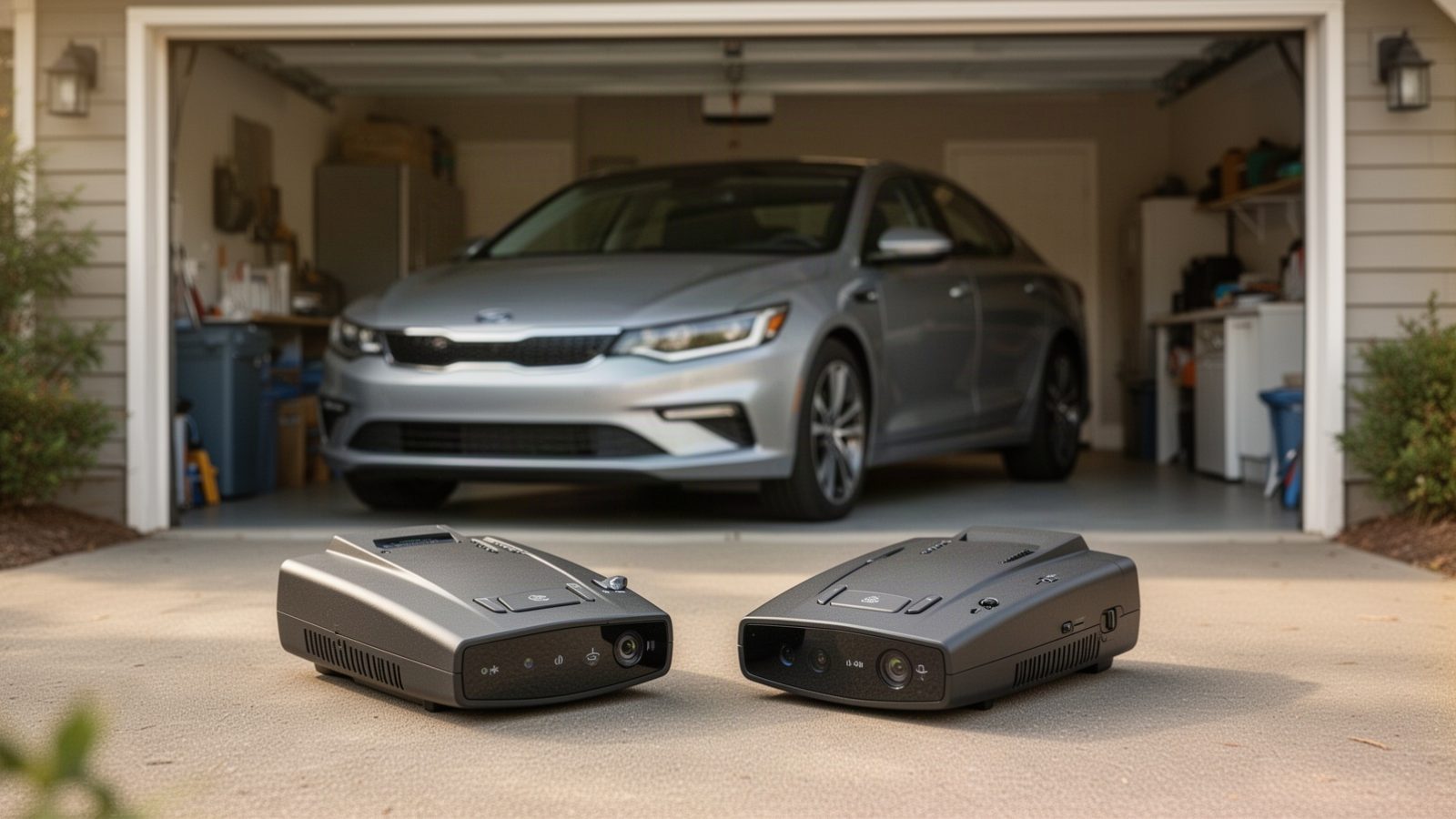
Five well-known radar detectors from Uniden, Escort and Cobra compared — with notes on false-alert filtering, directional arrows and where detectors are prohibited.
As an Amazon Associate I earn from qualifying purchases. When you buy through links on this page, we may earn a commission at no extra cost to you. Learn more
A radar detector listens for the radio signals used by police speed-measuring radar and warns you when it picks them up. On a long highway trip, a good one acts as an extra set of eyes, prompting you to check your speed before you reach a speed trap or work zone. Modern detectors also flag red-light and speed cameras from GPS databases, and some share alerts with other drivers through an app.
The hard part isn’t sensitivity — today’s better detectors all have long range. It is filtering. Blind-spot monitors and adaptive cruise systems on other cars emit signals that trigger constant false alerts, so GPS lockouts and smart filters often matter more than raw range. Before anything else, remember that detectors are prohibited in some places, including Virginia, Washington, D.C. and commercial vehicles, so check your local laws. We compared popular detectors from established brands on antennas, filtering, GPS features and connectivity, and picked the best options for different drivers.
Our top picks
-
1
 Illustration
Best overall
Uniden R7 Radar/Laser Detector
Highway drivers who want top performance without a subscription
AntennasFront and rearDirection arrowsYesGPSBuilt-in -
2
 Illustration
Best connected
Escort MAX 360c MKII Radar/Laser Detector
Drivers who want app alerts and automatic updates
AntennasFront and rearDirection arrowsYesGPSBuilt-in -
3
 Illustration
Best for long road trips
Escort Redline 360c Radar/Laser Detector
Rural and interstate drivers who want maximum warning
AntennasFront and rearDirection arrowsYesGPSBuilt-in -
4
 Illustration
Best mid-range
Uniden R4 Radar/Laser Detector
Drivers who want strong range and GPS without arrows
AntennasFront-facingDirection arrowsNoGPSBuilt-in -
5
 Illustration
Best budget
Cobra RAD 480i Radar/Laser Detector
Occasional drivers who want basic alerts and an app
AntennasFront-facingDirection arrowsNoGPSVia phone app
Uniden R7 Radar/Laser Detector
Illustration
A dual-antenna detector with directional arrows, built-in GPS and a reputation for long range.
Best for: Highway drivers who want top performance without a subscription- Antennas
- Front and rear
- Direction arrows
- Yes
- GPS
- Built-in
- App connection
- None
What we like
- Strong reputation for long detection range
- Directional arrows from front and rear antennas
- GPS lockouts and filters to reduce false alerts
- No app or subscription needed
Keep in mind
- No Bluetooth app or crowd-sourced alerts
- More settings to learn than simpler models
Uniden’s R7 earned a big following among radar enthusiasts by offering flagship-level detection performance and directional arrows without flagship pricing. Front and rear antennas tell you whether a signal is ahead or behind, and built-in GPS supports lockouts for repeat false alerts and red-light camera warnings.
Owners often point out its range and its configurability. Filters for blind-spot-monitor signals and other common false alerts can be tuned in detail, which matters on busy highways.
It has no app connection or crowd-sourced alerts, and the menu takes some time to learn. Before buying, check that radar detectors are legal where you drive — they are prohibited in some places, such as Virginia and Washington, D.C.
Bottom line: The best performance-focused detector for drivers who want arrows and long range.
Escort MAX 360c MKII Radar/Laser Detector
Illustration
A front-and-rear detector with directional arrows, GPS, Wi-Fi updates and app-based shared alerts.
Best for: Drivers who want app alerts and automatic updates- Antennas
- Front and rear
- Direction arrows
- Yes
- GPS
- Built-in
- App connection
- Wi-Fi updates and Bluetooth app
What we like
- Directional arrows with front and rear antennas
- Wi-Fi updates without plugging into a computer
- App connection for shared alerts and camera warnings
- GPS-based false-alert learning
Keep in mind
- Premium-priced
- Some app features depend on your phone’s data and battery
Escort’s MAX 360c MKII combines a dual-antenna detector with connected features. Arrows show whether a threat is ahead, beside or behind, GPS lets it learn and ignore stationary false alerts on routes you drive often, and built-in Wi-Fi keeps the firmware and camera databases current.
Pairing it with Escort’s app over Bluetooth adds alerts shared by other drivers, which can flag speed traps before the detector picks them up.
All of that comes at a premium price, and some features lean on your phone. Check local laws before you buy: detectors are prohibited in some places, including Virginia, Washington, D.C. and commercial vehicles.
Bottom line: The pick for drivers who want a top-tier detector with shared alerts and automatic updates.
Escort Redline 360c Radar/Laser Detector
Illustration
Escort’s long-range flagship line with dual antennas, directional arrows, GPS and connected features.
Best for: Rural and interstate drivers who want maximum warning- Antennas
- Front and rear
- Direction arrows
- Yes
- GPS
- Built-in
- App connection
- Wi-Fi updates and Bluetooth app
What we like
- Built for long-range warning on open highways
- Front and rear antennas with arrows
- GPS, Wi-Fi updates and app alerts
- Redline name has a long track record
Keep in mind
- Premium-priced
- Larger body than compact detectors
The Redline name has been Escort’s long-range flagship for years, and the Redline 360c brings that focus together with directional arrows, GPS and connectivity. It is designed to give the earliest possible warning on open interstates and rural highways, where early notice is most useful.
Front and rear antennas show where signals are coming from, GPS helps filter repeat false alerts, and Wi-Fi and app features keep it updated and connected to shared alerts.
It is premium-priced and physically larger than some rivals, and in dense city traffic the extra range matters less than filtering. Check the law where you drive, as detectors are prohibited in some places, such as Virginia and Washington, D.C.
Bottom line: A strong long-range choice for drivers who spend hours on open highways.
Uniden R4 Radar/Laser Detector
Illustration
A single-antenna detector with built-in GPS, voice alerts and Uniden’s long-range focus.
Best for: Drivers who want strong range and GPS without arrows- Antennas
- Front-facing
- Direction arrows
- No
- GPS
- Built-in
- App connection
- None
What we like
- Long-range performance for the price
- Built-in GPS for lockouts and camera alerts
- Voice alerts keep your eyes on the road
- Compact single-antenna design
Keep in mind
- No directional arrows or rear antenna
- No app connection
The Uniden R4 takes much of the long-range focus that made the brand popular and puts it in a simpler, more affordable package. It has a single front-facing antenna rather than front and rear antennas, so there are no directional arrows, but it keeps built-in GPS for lockouts and red-light and speed camera alerts.
Voice alerts announce what the detector has picked up, so you don’t need to glance at the display.
The trade-off is context: without arrows, you have to judge from signal strength whether a threat is ahead or behind. For many commuters, that is fine. Check that detectors are legal where you drive; they are prohibited in places such as Virginia, Washington, D.C. and in commercial vehicles.
Bottom line: Strong range and GPS filtering at a mid-priced level, minus the arrows.
Cobra RAD 480i Radar/Laser Detector
Illustration
An affordable detector that pairs with Cobra’s iRadar app for shared alerts using your phone’s GPS.
Best for: Occasional drivers who want basic alerts and an app- Antennas
- Front-facing
- Direction arrows
- No
- GPS
- Via phone app
- App connection
- Bluetooth (iRadar app)
What we like
- Budget-friendly entry into radar detection
- Bluetooth link to Cobra’s iRadar app for shared alerts
- Filter for common false alerts
- Compact and simple to set up
Keep in mind
- Shorter range than premium detectors
- GPS-based features rely on the phone app
Cobra’s RAD 480i is an affordable way to try a radar detector without committing to premium pricing. It covers radar and laser, includes filtering aimed at common false alerts, and pairs over Bluetooth with Cobra’s iRadar app, which uses your phone for location features and shared alerts from other drivers.
For occasional highway trips, that combination offers useful warnings at a fraction of the cost of flagship models.
Range and filtering are not in the same league as the Uniden and Escort models here, and there are no directional arrows. Many location features depend on the app running on your phone. Check local laws first: detectors are prohibited in some places, including Virginia, Washington, D.C. and commercial vehicles.
Bottom line: A budget-friendly starter detector for drivers who only need occasional alerts.
Side-by-side comparison
| Product | Antennas | Direction arrows | GPS | App connection | Score |
|---|---|---|---|---|---|
| Uniden R7 Radar/Laser DetectorBest overall | Front and rear | Yes | Built-in | None | 9.2 |
| Escort MAX 360c MKII Radar/Laser DetectorBest connected | Front and rear | Yes | Built-in | Wi-Fi updates and Bluetooth app | 9.0 |
| Escort Redline 360c Radar/Laser DetectorBest for long road trips | Front and rear | Yes | Built-in | Wi-Fi updates and Bluetooth app | 8.9 |
| Uniden R4 Radar/Laser DetectorBest mid-range | Front-facing | No | Built-in | None | 8.5 |
| Cobra RAD 480i Radar/Laser DetectorBest budget | Front-facing | No | Via phone app | Bluetooth (iRadar app) | 7.9 |
Specifications are from manufacturer listings at the time of writing and can change between production runs.
Check the law first
Radar detectors are legal in passenger cars in most of the US, but not everywhere. They are prohibited in Virginia and Washington, D.C., in commercial vehicles under federal rules, and on many military bases, and some states restrict anything mounted on the windshield. Laws change, so check the current rules for every state you drive in. Nothing in this guide is legal advice, and a detector is never a reason to speed.
Range matters, filtering matters more
- K-band false alerts come from blind-spot monitoring and collision-avoidance systems on nearby cars, plus automatic doors at stores. Good detectors filter these electronically.
- GPS lockouts let the detector learn and silence stationary false alerts on your regular routes.
- Auto-mute and city modes reduce constant beeping in town.
A detector with slightly less range but strong filtering is usually much easier to live with than a hypersensitive one that cries wolf.
Directional arrows and rear antennas
Detectors with front and rear antennas show arrows indicating whether a signal is ahead, beside or behind you. That context helps you judge whether an alert is a speed trap you are approaching or a signal you have already passed. Single-antenna detectors cost less but give less information.
Connected features
Bluetooth and Wi-Fi models link to phone apps for firmware updates, red-light and speed-camera databases and crowd-sourced alerts from other drivers. These can be genuinely useful, but they rely on your phone’s data and battery, and the alerts are only as good as the community reporting them.
Mounting and power
Most detectors use a windshield suction mount and plug into a 12-volt socket. Mount it high and centered with a clear view ahead and behind, without blocking your line of sight. For a cleaner install, hardwire kits and mirror-mount power taps are available — fuse boxes and mirror wiring differ, so confirm the right parts for your make, model and year, or use a professional installer. Some vehicles have metallic-coated or heated windshields that can weaken reception; check your owner’s manual.
What a detector can’t do
Laser (lidar) guns aim a narrow beam at a single car and measure speed almost instantly, so a laser alert usually means you have already been measured. Instant-on radar, aircraft enforcement and average-speed cameras also limit what any detector can warn you about. The surest way to avoid a ticket is to drive at a safe, legal speed.
Frequently asked questions
Are radar detectors legal?
They are legal in passenger vehicles in most US states, but prohibited in some places, including Virginia, Washington, D.C., commercial vehicles and many military bases. Rules change and some states restrict windshield mounting, so check the current laws for each state you drive in.
Do radar detectors detect laser?
Most detect laser, but laser guns measure a single vehicle almost instantly, so an alert usually means your speed has already been taken. It can still warn you if laser is being used on cars ahead.
Why does my detector keep going off for no reason?
The most common cause is K-band signals from blind-spot and collision-avoidance systems on other cars, plus automatic doors. Turn on the detector’s filters, use GPS lockouts on familiar routes and keep the firmware updated.
Are directional arrows worth paying for?
For frequent highway drivers, yes. Knowing whether a signal is ahead or behind helps you judge real threats from signals you have already passed. For occasional use, a single-antenna model is fine.
Will a radar detector work in my car?
Most work in any vehicle with a 12-volt socket, but some cars have metallic-coated or heated windshields that reduce reception, and power options differ. Check your owner’s manual for your make, model and year, and confirm the right hardwire or mirror-power parts if you want a cleaner install.
How we picked
We compared antenna layout, directional alerts, false-alert filtering, GPS features, connectivity and update support for popular radar detectors from established brands, and reviewed where detectors are restricted. Our picks and scores are based on this research — we have not tested these products hands-on. Brands cannot pay to be included. Read our full method.