






















The best digital voice recorders
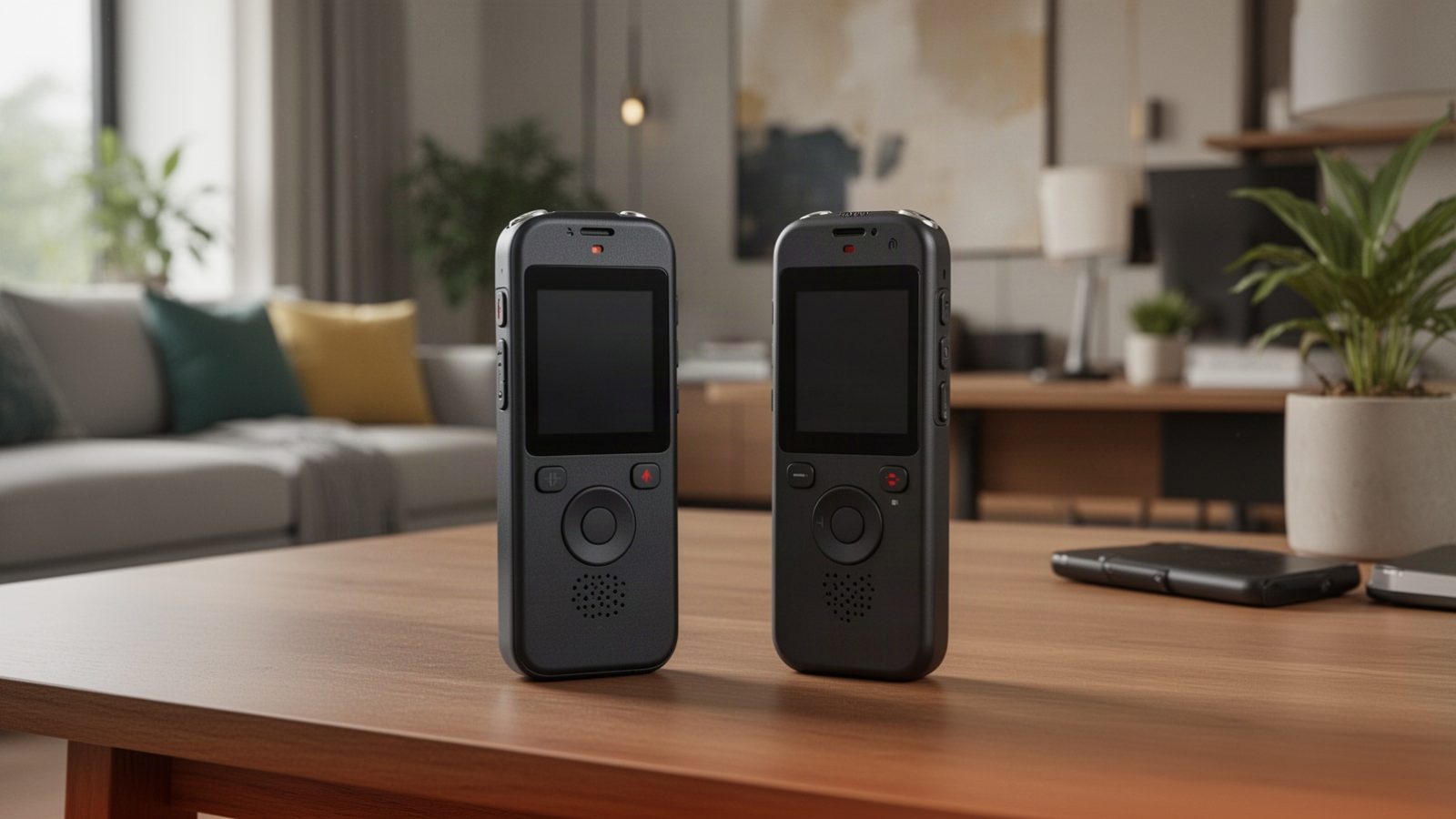
Five digital voice recorders compared — simple Sony and OM System dictation recorders for lectures and meetings, plus Zoom and Tascam stereo recorders for music and podcasts.
As an Amazon Associate I earn from qualifying purchases. When you buy through links on this page, we may earn a commission at no extra cost to you. Learn more
Your phone can record audio, so why buy a dedicated recorder? Because a recorder does one job without interruption. It won’t stop when a call comes in, drain your phone battery during a three-hour lecture or run out of storage halfway through an interview. Dedicated microphones and noise filters also capture clearer voices from across a table, and physical buttons make it easy to start recording without fumbling with an app.
Recorders fall into two groups. Voice recorders from brands like Sony and OM System (formerly Olympus) are slim, simple and built for speech — lectures, meetings, dictation and interviews. Handheld stereo recorders from Zoom and Tascam are built for higher-quality audio such as music rehearsals, podcasts and sound for video. We compared long-running, widely available models in both groups, looking at microphones, storage, power, file formats and ease of use, and picked the best for different needs.
Our top picks
-
1
 Illustration
Best overall
Sony ICD-UX570 Voice Recorder
Students, meetings and everyday recording
Storage4GB + microSD slotPowerBuilt-in rechargeable batteryBest suited toLectures, meetings and notes -
2
 Illustration
Best for music and podcasts
Zoom H1essential Handy Recorder
Musicians, podcasters and video creators
StoragemicroSD cardPowerAAA batteries or USB-CBest suited toMusic, podcasts and field audio -
3
 Illustration
Best for simplicity
Sony ICD-PX370 Voice Recorder
Dictation, reminders and users who want simple controls
Storage4GB + microSD slotPowerAAA batteriesBest suited toDictation and simple notes -
4
 Illustration
Best for interviews
OM System WS-883 Voice Recorder
Interviews, focus groups and lectures
Storage8GB + microSD slotPowerRechargeable AAA batteries (USB charging)Best suited toInterviews and lectures -
5
 Illustration
Best for video creators
Tascam DR-05X Stereo Recorder
Recording audio for video and music practice
StoragemicroSD cardPowerAA batteries or USBBest suited toVideo audio and music practice
Sony ICD-UX570 Voice Recorder
Illustration
A slim, rechargeable Sony recorder with a built-in USB plug, clear display and expandable storage.
Best for: Students, meetings and everyday recording- Storage
- 4GB + microSD slot
- Power
- Built-in rechargeable battery
- Best suited to
- Lectures, meetings and notes
What we like
- Slim, pocketable design
- Built-in USB plug for charging and file transfer
- Records MP3 or higher-quality linear PCM
- Clear display and straightforward menus
Keep in mind
- Built-in battery can’t be swapped mid-day
- Small buttons
- Not designed for music recording
The Sony ICD-UX570 has been one of the most recommended voice recorders for years because it balances simplicity, quality and portability. It is slim enough to slip into a shirt pocket, and a USB plug slides out of the body so you can charge it and copy files to a computer without a cable.
It records in MP3 for long sessions or linear PCM for higher quality, stores recordings on 4GB of internal memory, and accepts a microSD card for more space. Sony’s recording presets and noise-reduction options help voices stand out in lectures and meetings, and the display is easy to read.
The built-in battery means you can’t swap in fresh cells mid-day, so charge it the night before long sessions. For most students and professionals, it is the best all-round recorder.
Bottom line: The best all-round voice recorder for lectures, meetings and everyday notes.
Zoom H1essential Handy Recorder
Illustration
A compact stereo recorder with 32-bit float recording, X/Y microphones and USB audio-interface mode.
Best for: Musicians, podcasters and video creators- Storage
- microSD card
- Power
- AAA batteries or USB-C
- Best suited to
- Music, podcasts and field audio
What we like
- 32-bit float recording makes setting levels nearly foolproof
- X/Y stereo microphones for natural sound
- Works as a USB microphone or interface
- Audio voice guidance for menus
Keep in mind
- Larger than pocket voice recorders
- Needs a microSD card
- Overkill for simple dictation
Zoom’s H1 recorders are a go-to for affordable high-quality audio, and the H1essential adds 32-bit float recording. In practical terms, that means you don’t have to set input levels: quiet passages and loud peaks can be adjusted afterward on a computer, which removes the most common way recordings get ruined.
Its X/Y stereo microphones capture music rehearsals, ambient sound and podcasts with a natural stereo image, and it can work as a USB audio interface for a computer. Zoom also added spoken menu guidance, which makes the recorder easier to operate, including for users with low vision.
It is larger than a pocket voice recorder, records to a microSD card you supply, and is built for audio quality rather than dictation conveniences. For musicians and creators, it is the best value in the category.
Bottom line: The best affordable recorder for music, podcasts and creative audio.
Sony ICD-PX370 Voice Recorder
Illustration
A budget-friendly, battery-powered Sony recorder with straightforward controls and expandable storage.
Best for: Dictation, reminders and users who want simple controls- Storage
- 4GB + microSD slot
- Power
- AAA batteries
- Best suited to
- Dictation and simple notes
What we like
- Straightforward controls
- Runs on standard AAA batteries
- Expandable storage with microSD
- Budget-friendly
Keep in mind
- Basic display
- Less refined sound than the UX570
- No built-in rechargeable battery
The ICD-PX370 is Sony’s no-fuss recorder. It runs on AAA batteries, so you can swap in fresh ones during a long day, and the controls are simple enough that you can start recording almost without looking.
It stores recordings on 4GB of internal memory, with a microSD slot for more, and saves in MP3 so files stay small and easy to share. Sony’s scene settings help with meetings, dictation and conversations, and it connects to a computer over USB for file transfer.
The display is basic and recordings aren’t as refined as the UX570’s. For dictation, reminders, simple meeting notes or anyone who just wants a record button, it is a dependable, budget-friendly choice.
Bottom line: A simple, affordable recorder that is easy for anyone to use.
OM System WS-883 Voice Recorder
Illustration
A stereo voice recorder from the former Olympus line, with angled microphones, 8GB memory and a Simple Mode.
Best for: Interviews, focus groups and lectures- Storage
- 8GB + microSD slot
- Power
- Rechargeable AAA batteries (USB charging)
- Best suited to
- Interviews and lectures
What we like
- Two directional microphones angled for stereo
- 8GB internal memory plus microSD
- Simple Mode with large text
- Recharges standard-size batteries over USB
Keep in mind
- No Bluetooth or app features
- Menus can feel dated
- Minor setup needed to get the most from it
OM System took over Olympus’s well-regarded voice recorder line, and the WS-883 continues its focus on clear speech. Two directional microphones set at a 90-degree angle record in stereo, which helps separate voices in interviews and group discussions when you play recordings back.
It has 8GB of internal memory, the most among the voice recorders here, plus a microSD slot. It uses rechargeable AAA batteries that charge over USB, so you get the convenience of recharging with the flexibility of swapping in standard batteries when needed. A Simple Mode with large text makes it friendly for less technical users, and a voice filter helps with playback.
There’s no Bluetooth or app, and the menus feel dated. For interviews and lectures, though, its stereo microphones and generous memory make it a strong choice.
Bottom line: A capable stereo voice recorder for interviews and group recordings.
Tascam DR-05X Stereo Recorder
Illustration
A budget-friendly stereo recorder with omnidirectional mics, camera mounting and USB audio-interface mode.
Best for: Recording audio for video and music practice- Storage
- microSD card
- Power
- AA batteries or USB
- Best suited to
- Video audio and music practice
What we like
- Omnidirectional stereo mics capture a natural room sound
- Mounts on a camera or tripod
- Works as a USB audio interface
- Runs on standard AA batteries
Keep in mind
- Picks up handling noise when held
- Menus take some learning
- Needs a microSD card
The Tascam DR-05X is a long-running favorite among video creators and musicians on a budget. Its omnidirectional stereo microphones capture a natural, room-filling sound that suits rehearsals, acoustic performances and ambient audio.
It has a threaded mount so you can attach it to a camera or tripod, and an output that can send audio to a camera for syncing. It also works as a USB audio interface, and it runs on standard AA batteries, which are easy to find anywhere.
Handheld recording can pick up handling noise, so mount it or set it down when possible, and the menus take a little learning. As an affordable way to get better audio for video and music practice, it is a solid choice.
Bottom line: A budget-friendly stereo recorder that pairs well with cameras.
Side-by-side comparison
| Product | Storage | Power | Best suited to | Score |
|---|---|---|---|---|
| Sony ICD-UX570 Voice RecorderBest overall | 4GB + microSD slot | Built-in rechargeable battery | Lectures, meetings and notes | 9.1 |
| Zoom H1essential Handy RecorderBest for music and podcasts | microSD card | AAA batteries or USB-C | Music, podcasts and field audio | 9.0 |
| Sony ICD-PX370 Voice RecorderBest for simplicity | 4GB + microSD slot | AAA batteries | Dictation and simple notes | 8.7 |
| OM System WS-883 Voice RecorderBest for interviews | 8GB + microSD slot | Rechargeable AAA batteries (USB charging) | Interviews and lectures | 8.6 |
| Tascam DR-05X Stereo RecorderBest for video creators | microSD card | AA batteries or USB | Video audio and music practice | 8.5 |
Specifications are from manufacturer listings at the time of writing and can change between production runs.
Voice recorder or stereo field recorder?
Voice recorders are slim enough for a shirt pocket, record compressed MP3 files that keep storage use low, and include speech-focused features such as voice-activated recording and noise filters. They are the right tool for students, journalists, professionals and anyone dictating notes.
Stereo field recorders such as the Zoom H1essential and Tascam DR-05X have larger stereo microphones, record high-resolution WAV files and often double as USB microphones for a computer. Choose one for music, podcasts, sound effects or audio for video.
Microphones and recording modes
Look for recording presets or scene modes that adjust sensitivity for a close conversation versus a lecture hall. A low-cut filter reduces rumble from air conditioning and traffic. For interviews, place the recorder between speakers; for lectures, sit near the front, since even good microphones struggle with distance and room echo. Set the recorder on a folded cloth or notebook rather than a bare table, which transmits taps and vibrations, and make a short test recording before the important part begins.
Storage, file formats and transfer
Voice recorders typically include several gigabytes of internal memory plus a microSD slot, which is enough for many hours of MP3 recordings. Field recorders record to a microSD card, so budget for a good-quality card. Recorders with a built-in USB plug make transfers easy — no cable to forget. Back up recordings to a computer or cloud storage regularly, then clear space on the recorder so it never fills up mid-session.
Power
Some recorders use built-in rechargeable batteries, which are convenient but must be charged. Others use AA or AAA batteries, which you can swap in seconds during a long day. Rechargeable AA or AAA cells are a good compromise. Follow the manufacturer’s instructions for battery type and charging.
Features worth paying for
- Voice-activated recording skips silences during long sessions.
- Playback speed control helps when transcribing.
- 32-bit float recording, offered on the Zoom H1essential, makes it very difficult to ruin a recording by setting levels too high or too low.
- A simple mode with large text helps older users.
- A headphone jack to check recordings as they happen.
Recording etiquette and the law
Laws on recording conversations vary by state, and some require the consent of everyone being recorded. Ask permission before recording meetings, interviews or lectures, and check your school’s or employer’s policies.
Frequently asked questions
Is a voice recorder better than my phone?
For long or important recordings, often yes. A dedicated recorder won’t be interrupted by calls or notifications, has its own battery and storage, and many have microphones and filters tuned for speech. For quick voice memos, your phone is fine.
Can voice recorders transcribe speech to text?
Most simple recorders don’t transcribe on the device. Transfer the audio files to a computer or phone and use transcription software or a service to convert them to text.
Can I use a handheld recorder as a USB microphone?
Several stereo recorders can, including the Zoom H1essential and Tascam DR-05X, which can work as USB audio interfaces with a computer. Check the maker’s compatibility information for your operating system.
What file format should I record in?
Use MP3 for lectures, meetings and dictation to save space. Use WAV for music, podcasts and video audio, where quality and editing flexibility matter more than file size.
Is it legal to record a conversation?
It depends on where you are. Some states require everyone in the conversation to agree to being recorded. When in doubt, ask permission and follow local laws and any school or workplace policies.
How we picked
We compared manufacturer specifications for microphones, storage, power, file formats, computer connection and recording features, along with published reviews of voice clarity and ease of use, for long-running voice recorders and handheld stereo recorders widely available in the US. Our picks and scores are based on this research — we have not tested these products hands-on. Brands cannot pay to be included. Read our full method.