






















The best broths and stocks for soups and sauces
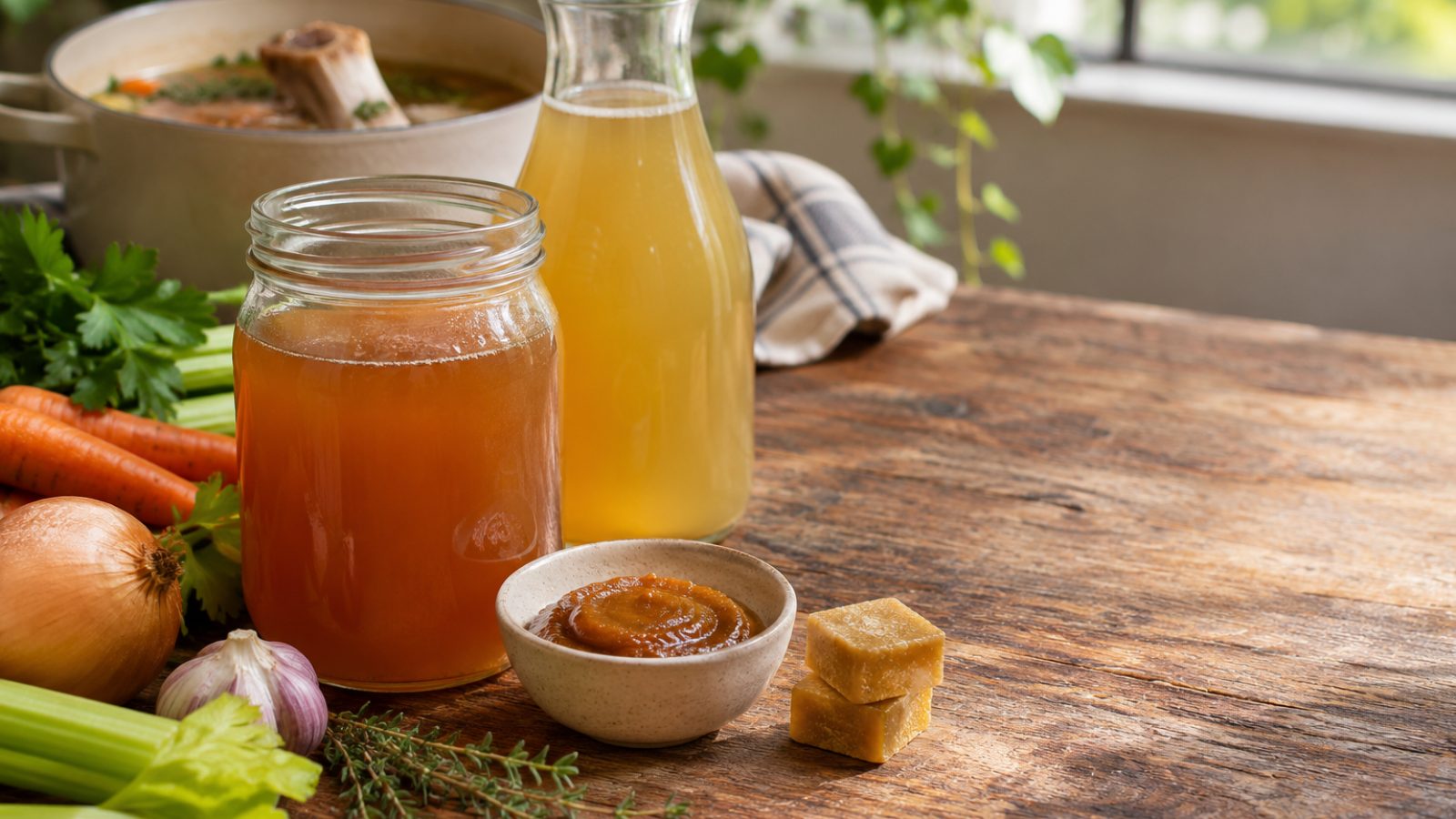
Six broths and stocks compared — an everyday chicken broth, an unsalted stock, an organic carton, a vegetable broth, a concentrated base and a sipping bone broth.
As an Amazon Associate I earn from qualifying purchases. When you buy through links on this page, we may earn a commission at no extra cost to you. Learn more
Store-bought broth is one of the hardest-working ingredients in the pantry. It goes into soups and stews, of course, but also pan sauces, gravies, risotto, braises and pots of rice and grains, where it adds savory depth that water can’t. Because it forms the backbone of so many dishes, a broth that tastes flat, overly salty or oddly sweet can drag down everything it touches.
The shelf is crowded with cartons, cans, jars of paste and newer bone broths, labeled broth, stock or base. Those names do mean slightly different things, and the salt level varies widely. We compared widely available brands on type, flavor, salt level, format and convenience, and picked the best options for everyday cooking, sauces you’ll reduce, organic and vegetarian kitchens, saving cupboard space and sipping from a mug.
Our top picks
-
1
 Illustration
Best overall
Swanson Chicken Broth
Everyday soups, rice and weeknight cooking
TypeBrothFlavorChickenFormatCarton or can -
2
 Illustration
Best unsalted stock
Kitchen Basics Unsalted Chicken Stock
Pan sauces, gravies, risotto and anything you reduce
TypeStockFlavorChickenFormatCarton -
3
 Illustration
Best organic
Pacific Foods Organic Free Range Chicken Broth
Organic shoppers and everyday soups
TypeBrothFlavorChickenFormatCarton -
4
 Illustration
Best vegetable broth
Pacific Foods Organic Vegetable Broth
Vegetarian and vegan soups, stews and grains
TypeBrothFlavorVegetableFormatCarton -
5
 Illustration
Best concentrate
Better Than Bouillon Roasted Chicken Base
Saving space and making exactly as much broth as you need
TypeConcentrated baseFlavorRoasted chickenFormatJar (paste) -
6
 Illustration
Best for sipping
Kettle & Fire Chicken Bone Broth
Sipping from a mug and rich, full-bodied soups
TypeBone brothFlavorChickenFormatCarton
Swanson Chicken Broth
Illustration
A familiar, well-balanced chicken broth that works in almost any everyday recipe.
Best for: Everyday soups, rice and weeknight cooking- Type
- Broth
- Flavor
- Chicken
- Format
- Carton or can
- Salt
- Regular (lower-sodium versions sold)
What we like
- Balanced, savory chicken flavor
- Works in soups, rice, stuffing and casseroles
- Sold almost everywhere in cartons and cans
- Several salt levels available
Keep in mind
- Regular version can be too salty for reduced sauces
- Lighter body than stock or bone broth
Swanson is the broth many recipes were written with, and it remains a dependable default. The chicken broth has a balanced, savory flavor that doesn’t taste overly sweet or vegetal, so it slips into soups, rice, stuffing, casseroles and quick braises without drawing attention to itself.
It’s also one of the easiest broths to find, in cartons and cans of various sizes, and the brand sells lower-sodium versions alongside the regular one.
For pan sauces and gravies that you reduce, choose one of the lower-salt options, since regular broth concentrates as it simmers. And if you want more body for a special soup, a stock or bone broth will give a richer result.
Bottom line: The most versatile everyday chicken broth to keep in the pantry.
Kitchen Basics Unsalted Chicken Stock
Illustration
An unsalted stock that lets you control the seasoning in sauces and reductions.
Best for: Pan sauces, gravies, risotto and anything you reduce- Type
- Stock
- Flavor
- Chicken
- Format
- Carton
- Salt
- Unsalted
What we like
- No added salt — season to taste at the end
- Ideal for reductions, gravies and risotto
- Savory, roasted flavor
- Original salted version also sold
Keep in mind
- Tastes flat on its own until seasoned
- Not stocked in every store
When a recipe tells you to reduce stock by half, the salt in regular broth doubles in concentration. That’s why unsalted stock is the smart choice for pan sauces, gravies, braises and risotto, and Kitchen Basics Unsalted Chicken Stock is one of the most widely sold options.
It has a savory flavor and decent body, and because there’s no added salt, you season the finished dish exactly to taste. Sipped straight from the carton it tastes flat — that’s expected, and a pinch of salt brings it to life.
If you mostly make soups and don’t reduce liquids, the brand’s original salted stock or a regular broth is more convenient.
Bottom line: The best stock for cooks who want full control over seasoning.
Pacific Foods Organic Free Range Chicken Broth
Illustration
An organic chicken broth in a carton, with a clean, mild flavor.
Best for: Organic shoppers and everyday soups- Type
- Broth
- Flavor
- Chicken
- Format
- Carton
- Dietary notes
- USDA Organic
What we like
- USDA Organic, made with free-range chicken
- Clean, mild flavor that suits delicate soups
- Low-sodium version also sold
- Widely available in natural and mainstream stores
Keep in mind
- Milder flavor may need boosting for hearty dishes
- Premium-priced
Pacific Foods has long been a go-to for organic broths, and its Free Range Chicken Broth is the core of the range. It’s USDA Organic and has a clean, mild chicken flavor that works especially well in delicate soups, matzo ball soup, risotto and grain dishes where you don’t want the broth to dominate.
That mildness is the trade-off. In hearty stews or quick pan sauces, it can taste a little light; simmering it with onion, carrot, celery and a bay leaf first adds depth.
It costs more than conventional broths, but for organic households it’s one of the most consistent and easiest-to-find options.
Bottom line: A clean-tasting organic chicken broth for everyday cooking.
Pacific Foods Organic Vegetable Broth
Illustration
An organic, meat-free broth with a savory vegetable flavor.
Best for: Vegetarian and vegan soups, stews and grains- Type
- Broth
- Flavor
- Vegetable
- Format
- Carton
- Dietary notes
- USDA Organic, meat-free
What we like
- Meat-free for vegetarian cooking
- Savory, well-rounded vegetable flavor
- USDA Organic
- Useful for minestrone, lentil soup and grains
Keep in mind
- Vegetable broths can taste sweet in some dishes
- Premium-priced
Vegetable broth is notoriously hit-and-miss — some taste mostly of carrot and sweetness, others of little at all. Pacific Foods’ organic vegetable broth is one of the more balanced options, with a savory, rounded flavor that suits vegetable soups, lentil and bean dishes, risotto and grains.
It’s meat-free, so it works for vegetarian cooking, and as with the brand’s chicken broth it’s USDA Organic. Check the label if you need it to be certified vegan or allergen-free.
Like most vegetable broths, it can tilt slightly sweet in delicate dishes; a splash of soy sauce, miso or lemon at the end balances it.
Bottom line: A well-balanced organic vegetable broth for meat-free cooking.
Better Than Bouillon Roasted Chicken Base
Illustration
A rich, roasted chicken paste you mix with hot water — one jar makes many cups.
Best for: Saving space and making exactly as much broth as you need- Type
- Concentrated base
- Flavor
- Roasted chicken
- Format
- Jar (paste)
- Storage
- Refrigerate after opening
What we like
- Deep, roasted chicken flavor
- One small jar replaces many cartons
- Mix any amount, at any strength
- Stir straight into sauces, soups and rice
Keep in mind
- Saltier than most carton broths
- Must be refrigerated after opening
Better Than Bouillon has won over a lot of home cooks because it tastes far better than old-style cubes. The Roasted Chicken Base is a thick paste made with roasted chicken, and a spoonful stirred into hot water gives a rich, savory broth with more depth than many cartons.
It’s also practical. One small jar takes up a fraction of the space of a stack of cartons, keeps for a long time in the fridge after opening (check the label) and lets you make exactly the amount you need — a cup for a pan sauce or a big pot for soup. You can also stir it straight into rice cooking water, gravy or a stir-fry sauce.
The base leans salty, so use a little less than the label suggests in dishes you’ll reduce, and taste before adding more salt. The brand sells a reduced-sodium version too.
Bottom line: The most flavorful, space-saving way to keep broth on hand.
Kettle & Fire Chicken Bone Broth
Illustration
A slow-simmered, shelf-stable chicken bone broth with more body than regular broth.
Best for: Sipping from a mug and rich, full-bodied soups- Type
- Bone broth
- Flavor
- Chicken
- Format
- Carton
- Storage
- Shelf-stable until opened
What we like
- Richer, fuller body than regular broth
- Pleasant to sip warm from a mug
- Shelf-stable carton
- Adds depth to soups, ramen and sauces
Keep in mind
- Premium-priced per carton
- Smaller cartons than regular broth
Bone broth is simmered for much longer than regular broth, so it has a richer flavor and a fuller, sometimes slightly gelatinous body. Kettle & Fire is one of the best-known shelf-stable bone broth brands, and its chicken version is a good introduction.
Many people sip it warm from a mug, seasoned with a pinch of salt, pepper or a squeeze of lemon. It’s also a smart upgrade for dishes where body matters: ramen, chicken noodle soup, risotto and pan sauces.
The catch is cost: it’s considerably pricier per cup than ordinary broth, and the cartons are smaller. For everyday soups and rice, a regular broth makes more sense; keep bone broth for sipping and special dishes.
Bottom line: A rich, full-bodied bone broth that’s worth it for sipping and special soups.
Side-by-side comparison
| Product | Type | Flavor | Format | Salt | Score |
|---|---|---|---|---|---|
| Swanson Chicken BrothBest overall | Broth | Chicken | Carton or can | Regular (lower-sodium versions sold) | 9.0 |
| Kitchen Basics Unsalted Chicken StockBest unsalted stock | Stock | Chicken | Carton | Unsalted | 8.9 |
| Pacific Foods Organic Free Range Chicken BrothBest organic | Broth | Chicken | Carton | — | 8.6 |
| Pacific Foods Organic Vegetable BrothBest vegetable broth | Broth | Vegetable | Carton | — | 8.4 |
| Better Than Bouillon Roasted Chicken BaseBest concentrate | Concentrated base | Roasted chicken | Jar (paste) | — | 8.8 |
| Kettle & Fire Chicken Bone BrothBest for sipping | Bone broth | Chicken | Carton | — | 8.2 |
Specifications are from manufacturer listings at the time of writing and can change between production runs.
Broth, stock, bone broth and base
- Broth is typically made by simmering meat and vegetables. It’s seasoned and ready to use, with a lighter body.
- Stock is traditionally made with more bones, which gives more body. Store-bought stocks are often less seasoned, making them better for sauces.
- Bone broth is simmered longer from bones for a richer, more gelatinous result, and it’s often sold for sipping as well as cooking.
- Concentrated bases and bouillon are pastes, cubes or powders you mix with hot water. They save space and money but vary in flavor and salt.
In practice, brands use “broth” and “stock” loosely, so taste and the ingredient list matter more than the name.
Control the salt
If you reduce a liquid — for a pan sauce, gravy or braise — the salt concentrates as the water evaporates. Regular broth can turn a sauce too salty. Unsalted or reduced-sodium versions let you season at the end, to taste. For soups that aren’t reduced much, regular broth is fine.
Cartons vs. concentrates
Cartons are the most convenient: pour and go. Their downside is bulk and a limited life once opened. Concentrated bases take up a fraction of the space, let you make exactly as much as you need and let you adjust the strength, but you have to mix them and the flavor can lean salty. Bouillon cubes and powders are the most compact and budget-friendly of all, though they often taste flatter and saltier than pastes, so they’re best in soups and stews with plenty of other flavors.
Boost a store-bought broth
Simmer broth for 15–20 minutes with a few aromatics before using it in soup: onion, carrot, celery, garlic, a bay leaf, a Parmesan rind or a few peppercorns. Strain, and it tastes much closer to homemade.
Storage
Unopened cartons and jars keep in the pantry until their best-by date. Once opened, refrigerate and use within the time printed on the package. Freeze leftovers in ice-cube trays or small containers so you always have a few ounces for a pan sauce. Concentrated bases usually need refrigerating after opening.
Frequently asked questions
What’s the difference between broth and stock?
Traditionally, broth is made from meat and seasoned to sip or use as is, while stock is made from bones, has more body and is less seasoned. Store-bought products use the terms loosely, so check the label and taste.
Should I buy unsalted broth?
It’s the most flexible choice for sauces, gravies and anything you reduce, because you can season at the end. For everyday soups, regular broth is fine.
How long does broth last after opening?
Refrigerate it and use it within the time printed on the carton. If you won’t use it in time, freeze it in ice-cube trays or small containers.
Is a concentrated base as good as carton broth?
Good bases like Better Than Bouillon taste rich and savory, and you can adjust the strength. They tend to be saltier, so use slightly less than directed in dishes you’ll reduce.
Can I use bone broth in place of regular broth?
Yes. Bone broth is richer and more full-bodied, so it works well in soups, stews and sauces. It usually costs more, so many cooks save it for sipping or dishes where body matters.
How we picked
We compared broth and stock types, ingredient lists, salt options, formats, storage directions and availability for widely sold brands in the US, and weighed how each suits soups, sauces, grains and sipping. Our picks and scores are based on this research — we have not tested these products hands-on. Brands cannot pay to be included. Read our full method.