






















The best NAS devices for home and small offices
Six 2-bay and 4-bay NAS devices compared for home backups, photo libraries and media streaming — plus how to choose drives and why RAID is not a backup.
As an Amazon Associate I earn from qualifying purchases. When you buy through links on this page, we may earn a commission at no extra cost to you. Learn more
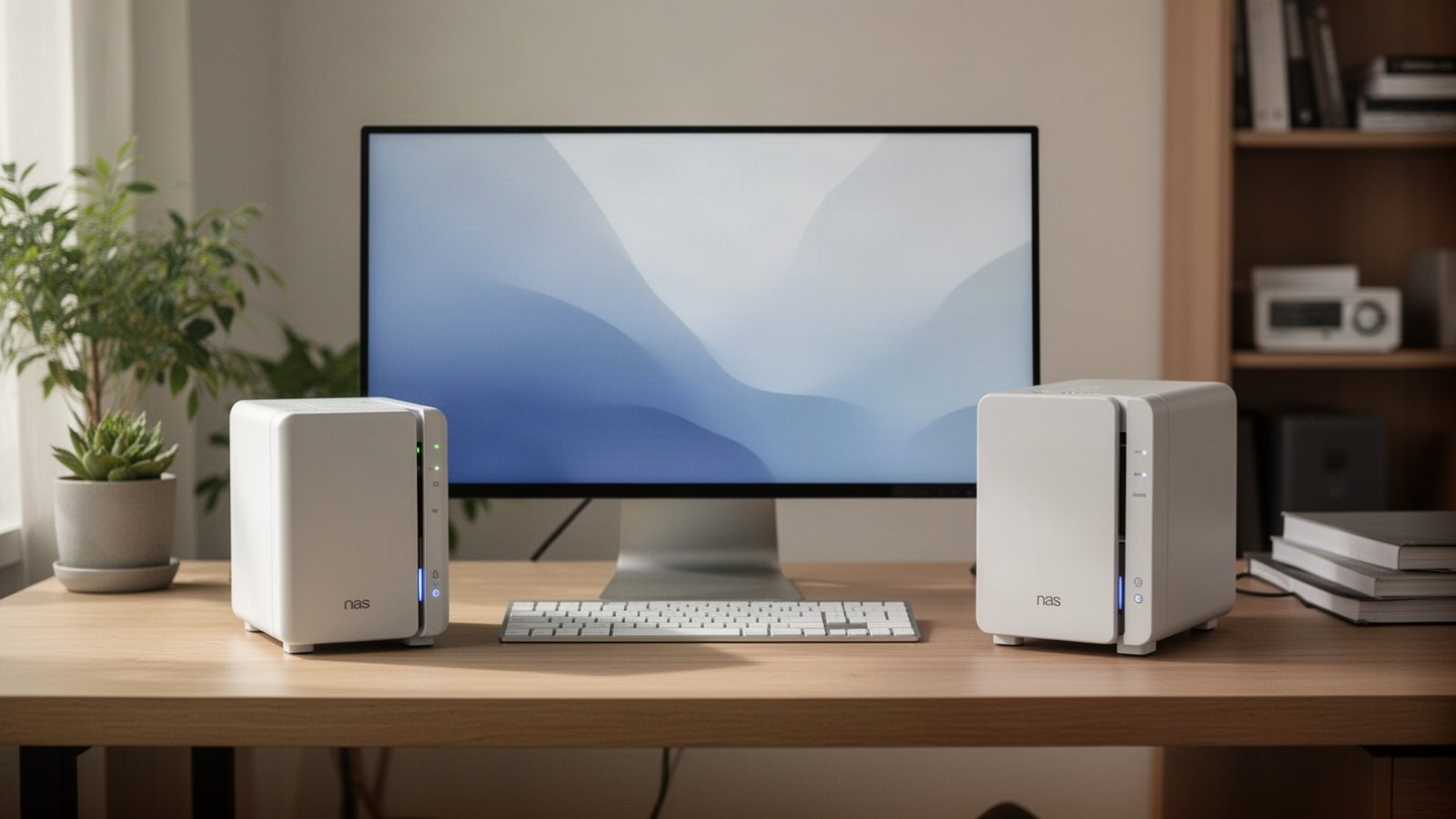
A NAS (network-attached storage) device is a small, always-on computer built to hold hard drives and share them over your home network. Plug it into your router and every computer can back up to it automatically, phones can upload photos to it instead of a paid cloud plan, and a media server app can stream your movie collection to TVs. Most also offer secure remote access, so your files are reachable away from home.
Choosing one comes down to software, drive bays and network speed. The software decides how easy backups, photo apps and remote access are to set up; the number of bays sets how much storage and redundancy you get; and 2.5GbE or 10GbE ports matter when several people work from the NAS at once. We compared popular models from Synology, QNAP and UGREEN on processor, memory, bays, network ports, expansion slots and software. Note that most NAS units are sold without drives, which you buy separately.
Our top picks
-
1
 Illustration
Best overall
Synology DiskStation DS225+ 2-Bay NAS
Homes that want the easiest, most polished NAS
Drive bays2ProcessorIntel Celeron J4125 (4-core)Network ports1 x 2.5GbE + 1 x 1GbE -
2
 Illustration
Best 4-bay
Synology DiskStation DS925+ 4-Bay NAS
Growing families, creators and small offices
Drive bays4ProcessorAMD Ryzen V1500B (4-core)Network ports2 x 2.5GbE -
3
 Illustration
Best value
UGREEN NASync DXP2800 2-Bay NAS
Value-focused buyers who want modern hardware
Drive bays2ProcessorIntel N100 (4-core)Network ports1 x 2.5GbE -
4
 Illustration
Best for fast networks
UGREEN NASync DXP4800 Plus 4-Bay NAS
Creators and offices with 10GbE networks
Drive bays4ProcessorIntel Pentium Gold 8505 (5-core)Network ports1 x 10GbE + 1 x 2.5GbE -
5
 Illustration
Best for media and tinkerers
QNAP TS-464 4-Bay NAS
Plex users and power users who want flexibility
Drive bays4ProcessorIntel Celeron N5095 (4-core)Network ports2 x 2.5GbE -
6
 Illustration
Best budget
QNAP TS-233 2-Bay NAS
Simple file sharing and backups on a budget
Drive bays2ProcessorARM Cortex-A55 (4-core)Network ports1 x 1GbE
Synology DiskStation DS225+ 2-Bay NAS
Illustration
A 2-bay NAS running Synology's beginner-friendly DSM software, with a 2.5GbE port and an Intel processor.
Best for: Homes that want the easiest, most polished NAS- Drive bays
- 2
- Processor
- Intel Celeron J4125 (4-core)
- Network ports
- 1 x 2.5GbE + 1 x 1GbE
- Memory
- 2GB DDR4 (expandable to 6GB)
What we like
- Synology DSM is the most polished NAS software for beginners
- Excellent backup, photo and file-sync apps
- 2.5GbE port for faster transfers
- Intel processor with integrated graphics helps with media apps
Keep in mind
- Only 2GB of memory as standard
- Drive policy changes on 2025 models mean you should check current compatibility rules
- Older processor than some rivals at similar prices
For most homes, the software matters more than the specs, and Synology's DSM is the easiest NAS software to live with. The DS225+ pairs it with two drive bays, an Intel Celeron J4125 processor and a 2.5GbE port alongside a standard 1GbE port, which is a meaningful speed boost over older 1GbE-only 2-bay models.
Setting up automatic computer backups, phone photo backup with Synology Photos and secure remote access takes a few guided steps. Mirroring two drives protects against a single drive failure, and snapshots help you recover from accidental deletions.
The hardware is modest for the price: 2GB of memory is enough for file sharing and backups, but add more if you plan to run several apps. Synology also changed and then relaxed its third-party drive rules for 2025 models, so check the current compatibility list before buying drives.
Bottom line: The best NAS for people who want reliable backups and photo storage without becoming a network admin.
Synology DiskStation DS925+ 4-Bay NAS
Illustration
A 4-bay Synology with an AMD Ryzen processor, ECC memory and two 2.5GbE ports.
Best for: Growing families, creators and small offices- Drive bays
- 4
- Processor
- AMD Ryzen V1500B (4-core)
- Network ports
- 2 x 2.5GbE
- Memory
- 4GB DDR4 ECC (expandable to 32GB)
- M.2 slots
- 2 x M.2 NVMe
What we like
- Four bays leave room to grow
- Two 2.5GbE ports for faster multi-user access
- ECC memory expandable to 32GB
- Runs Synology's full DSM app lineup well
Keep in mind
- No integrated graphics for video transcoding
- Premium-priced
- Check Synology's current drive rules before buying disks
The DS925+ is the step up for households and small offices that need more storage and more performance. Four bays let you start with a couple of drives and expand later, while RAID 5 or Synology's SHR gives more usable space than a mirrored pair. Two 2.5GbE ports, an AMD Ryzen V1500B processor and 4GB of ECC memory (expandable to 32GB) give it headroom for several users, virtual machines and containers.
It runs Synology's full software suite comfortably, including backup tools for whole computers, Synology Photos and Synology Drive for file sync across a team.
The one notable gap is video transcoding. The Ryzen chip has no integrated graphics, so if you want Plex to convert 4K video on the fly for older devices, an Intel-based NAS is the better fit. As with other 2025 Synology models, confirm the current drive-compatibility policy before buying disks.
Bottom line: A powerful, expandable Synology for multi-user homes and small offices that don't rely on video transcoding.
UGREEN NASync DXP2800 2-Bay NAS
Illustration
A 2-bay NAS with a modern Intel N100 chip, 8GB of DDR5 and two M.2 slots for strong hardware value.
Best for: Value-focused buyers who want modern hardware- Drive bays
- 2
- Processor
- Intel N100 (4-core)
- Network ports
- 1 x 2.5GbE
- Memory
- 8GB DDR5 (expandable)
- M.2 slots
- 2 x M.2 NVMe
What we like
- Modern Intel N100 with integrated graphics for media transcoding
- 8GB of DDR5 memory as standard
- Two M.2 slots for SSD storage or cache
- Simple UGOS Pro software with phone apps
Keep in mind
- UGOS Pro is newer and less mature than Synology DSM
- Fewer third-party integrations and apps
- Only one network port
UGREEN, better known for chargers and cables, entered the NAS market with hardware that undercuts older brands on value. The DXP2800 pairs two drive bays with an Intel N100 processor, 8GB of DDR5 memory, a 2.5GbE port and two M.2 slots for NVMe SSDs. That is more memory and a newer chip than many established 2-bay models.
The N100's integrated graphics handle video transcoding well, which makes the DXP2800 a good home for a Plex or Jellyfin media server, and UGREEN's UGOS Pro software covers file sharing, phone photo backup and Docker containers with a simple interface.
The trade-off is software maturity. UGOS Pro is younger than Synology's DSM and QNAP's QTS, with fewer built-in apps and integrations, so check that it supports the backup tools you rely on. For hardware value, though, it is hard to beat.
Bottom line: The best hardware for the money in a 2-bay NAS, especially for media servers.
UGREEN NASync DXP4800 Plus 4-Bay NAS
Illustration
A 4-bay NAS with a built-in 10GbE port, an Intel Pentium Gold chip and 8GB of DDR5.
Best for: Creators and offices with 10GbE networks- Drive bays
- 4
- Processor
- Intel Pentium Gold 8505 (5-core)
- Network ports
- 1 x 10GbE + 1 x 2.5GbE
- Memory
- 8GB DDR5 (expandable)
- M.2 slots
- 2 x M.2 NVMe
What we like
- Built-in 10GbE port, rare at this level
- Capable Intel processor with integrated graphics
- Four bays plus two M.2 slots
- 8GB of DDR5 memory as standard
Keep in mind
- 10GbE speed needs a 10GbE switch and computer to benefit
- UGOS Pro software is less mature than DSM or QTS
- Larger and louder than 2-bay units
Most NAS devices need an add-on card for 10GbE networking; the DXP4800 Plus has it built in, alongside a 2.5GbE port. Paired with a fast switch and a 10GbE-equipped computer, that lets video editors and photographers work with large files directly from the NAS at speeds no 1GbE or 2.5GbE port can match.
The rest of the hardware keeps up: an Intel Pentium Gold 8505 processor with integrated graphics for media transcoding, 8GB of DDR5 memory, four drive bays and two M.2 slots for SSD storage or caching.
As with the DXP2800, UGREEN's UGOS Pro software is the compromise. It covers the essentials well, but it doesn't have the depth of Synology's apps or the long track record. If you don't have — or plan to buy — 10GbE gear, a cheaper 4-bay unit makes more sense.
Bottom line: A fast, well-equipped 4-bay NAS for anyone ready to use 10GbE.
QNAP TS-464 4-Bay NAS
Illustration
A 4-bay NAS with an Intel Celeron, two 2.5GbE ports, M.2 slots, HDMI output and a PCIe expansion slot.
Best for: Plex users and power users who want flexibility- Drive bays
- 4
- Processor
- Intel Celeron N5095 (4-core)
- Network ports
- 2 x 2.5GbE
- Memory
- 4GB or 8GB (expandable)
- M.2 slots
- 2 x M.2 NVMe
What we like
- Intel graphics for media transcoding
- Two 2.5GbE ports and a PCIe slot for 10GbE upgrades
- HDMI output for direct-to-TV use
- Very flexible QTS software
Keep in mind
- QTS has a steeper learning curve than Synology DSM
- More settings to secure properly
- Memory varies by version, so check the listing
QNAP builds NAS devices for people who like options, and the TS-464 is a good example. It combines four drive bays, an Intel Celeron N5095 with integrated graphics, two 2.5GbE ports and two M.2 NVMe slots, then adds a PCIe slot for a 10GbE card and an HDMI port for connecting directly to a TV.
That makes it a strong media server: Plex and other apps can use the Intel graphics for transcoding, and the hardware leaves room to grow. QNAP's QTS software is packed with features, from virtual machines to containers and detailed storage settings.
The flip side is complexity. QTS asks more of you than Synology's DSM, and QNAP devices have been targeted by ransomware campaigns in the past, so turn on automatic updates, use strong passwords with two-factor sign-in and avoid exposing it directly to the internet.
Bottom line: A flexible, expandable 4-bay NAS for media fans and tinkerers who will keep it updated.
QNAP TS-233 2-Bay NAS
Illustration
An entry-level 2-bay NAS with an ARM processor for basic file sharing and computer backups.
Best for: Simple file sharing and backups on a budget- Drive bays
- 2
- Processor
- ARM Cortex-A55 (4-core)
- Network ports
- 1 x 1GbE
- Memory
- 2GB (not expandable)
What we like
- Budget-friendly way into NAS storage
- Handles file sharing, backups and photo uploads
- Compact, quiet design
- Runs QNAP's full QTS software
Keep in mind
- 1GbE port limits transfer speeds
- ARM processor struggles with transcoding and heavy apps
- Memory can't be upgraded
If you want central storage and automatic backups without spending much, the QNAP TS-233 is a sensible entry point. It is a compact 2-bay NAS with a quad-core ARM processor and 2GB of memory, enough for file sharing, computer backups and phone photo uploads.
It runs QNAP's QTS software, so the core features — shared folders, backup tools, remote access and photo apps — are the same ones found on QNAP's pricier models.
The limits are performance and headroom. A single 1GbE port caps transfers at about 110 MB/s, the ARM chip isn't built for video transcoding or many apps at once, and memory can't be expanded. If you plan to run a media server or several apps, step up to an Intel-based model such as the UGREEN DXP2800.
Bottom line: A budget-friendly NAS for straightforward backups and file sharing.
Side-by-side comparison
| Product | Drive bays | Processor | Network ports | Memory | Score |
|---|---|---|---|---|---|
| Synology DiskStation DS225+ 2-Bay NASBest overall | 2 | Intel Celeron J4125 (4-core) | 1 x 2.5GbE + 1 x 1GbE | 2GB DDR4 (expandable to 6GB) | 9.1 |
| Synology DiskStation DS925+ 4-Bay NASBest 4-bay | 4 | AMD Ryzen V1500B (4-core) | 2 x 2.5GbE | 4GB DDR4 ECC (expandable to 32GB) | 9.0 |
| UGREEN NASync DXP2800 2-Bay NASBest value | 2 | Intel N100 (4-core) | 1 x 2.5GbE | 8GB DDR5 (expandable) | 8.7 |
| UGREEN NASync DXP4800 Plus 4-Bay NASBest for fast networks | 4 | Intel Pentium Gold 8505 (5-core) | 1 x 10GbE + 1 x 2.5GbE | 8GB DDR5 (expandable) | 8.6 |
| QNAP TS-464 4-Bay NASBest for media and tinkerers | 4 | Intel Celeron N5095 (4-core) | 2 x 2.5GbE | 4GB or 8GB (expandable) | 8.5 |
| QNAP TS-233 2-Bay NASBest budget | 2 | ARM Cortex-A55 (4-core) | 1 x 1GbE | 2GB (not expandable) | 7.9 |
Specifications are from manufacturer listings at the time of writing and can change between production runs.
How many drive bays?
- 2-bay units are the sweet spot for most homes. Two mirrored drives (RAID 1) keep your data available if one drive fails.
- 4-bay units cost more up front but grow with you: start with two or three drives and add more later, and get more usable space from RAID 5 or Synology's SHR.
- Larger units mostly suit small businesses and serious media collectors.
RAID is not a backup
RAID keeps a NAS running when a drive dies. It does nothing if files are deleted, corrupted, encrypted by ransomware, or lost to theft, fire or a power surge. Keep a separate copy — on an external drive you rotate, a second NAS at another location or a cloud backup service — and turn on snapshots if your NAS supports them, so you can roll back accidental changes.
Choosing drives
Use NAS-rated hard drives, such as WD Red Plus or Seagate IronWolf, which are built for 24/7 operation in multi-drive enclosures, and avoid desktop drives that use SMR recording in RAID arrays. Before you buy, check the NAS maker's drive-compatibility list for your exact model. Synology in particular tightened its third-party drive rules for its 2025 Plus models and later relaxed them in a software update, so read the current policy before choosing drives. Buying identical drives keeps setup simple.
Processor, memory and ports
- Intel processors with integrated graphics handle video transcoding well, which helps Plex or Jellyfin stream to older TVs and phones.
- AMD Ryzen embedded chips used in some Synology models are strong for multiple users and virtual machines, but lack integrated graphics for transcoding.
- ARM chips in entry-level models are fine for file sharing and backups, but slower for apps and media.
- Memory: 4GB or more helps if you run several apps or containers; check how far it can be upgraded.
- Network: a 1GbE port limits transfers to roughly 110 MB/s. A 2.5GbE port, paired with a matching PC or switch, more than doubles that.
- M.2 slots can add an SSD cache or, on some models, fast SSD storage.
Software matters as much as hardware
Synology's DSM is the most polished for beginners, with strong backup, photo and file-sync apps. QNAP's QTS offers more hardware options and features but has a steeper learning curve. UGREEN's UGOS Pro is newer and simpler, paired with strong hardware for the money. Whichever you choose, turn on automatic security updates and two-factor sign-in.
Setup and security tips
Put the NAS on a battery backup (UPS) if you can, so power cuts don't interrupt writes. Don't open admin ports directly to the internet; use the maker's secure remote-access service or a VPN instead. Keep firmware updated — NAS devices are a common ransomware target — and keep that separate backup current.
Frequently asked questions
Do NAS devices come with hard drives?
Most are sold empty (diskless), so you buy drives separately and choose the capacity you need. Some retailers sell bundles with drives included. Check the maker's compatibility list before buying drives.
Is RAID the same as a backup?
No. RAID protects against a single drive failing, but not against deleted files, ransomware, theft, fire or a failed NAS. Keep at least one separate copy of important data, ideally off-site or in the cloud.
Can a NAS replace Google Photos or iCloud?
For many people, yes. Synology, QNAP and UGREEN all offer phone apps that back up photos automatically and let you browse them remotely. You become responsible for backups and updates, though, so pair the NAS with an off-site copy.
Can I run Plex on a NAS?
Yes, most current NAS devices can run Plex or Jellyfin. If you need to transcode video for older TVs, phones or remote streaming, an Intel-based model with integrated graphics handles it far better than an ARM or AMD Ryzen model.
How is a NAS different from an external hard drive?
An external drive connects to one computer at a time. A NAS sits on your network, so every computer and phone can reach it at once, it can run backup and media apps on its own, and it can protect against a drive failure with RAID.
How we picked
We compared manufacturer specifications for popular 2-bay and 4-bay NAS devices sold in the US — processor, memory and upgrade limits, drive bays, network ports, M.2 slots and the maker's software and drive-compatibility policies — and weighed how each suits home backups, photo storage, media streaming and small offices. Our picks and scores are based on this research; we have not tested these products hands-on. Brands cannot pay to be included. Read our full method.