






















The best vertical slow juicers
Four upright slow juicers compared on chute size, auger speed, motor, warranty and how much chopping and rinsing each one asks of you.
As an Amazon Associate I earn from qualifying purchases. When you buy through links on this page, we may earn a commission at no extra cost to you. Learn more
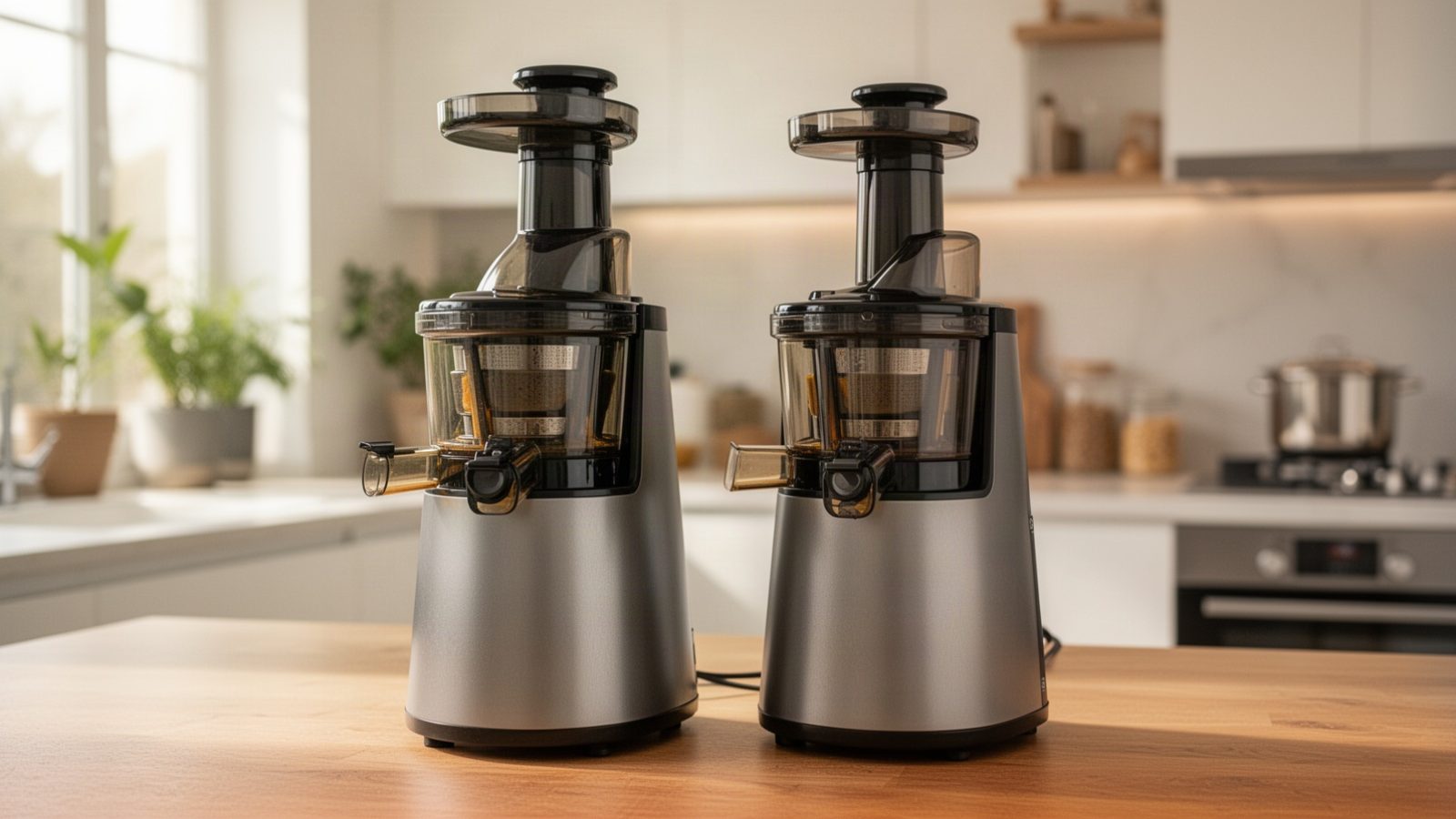
A vertical slow juicer, often sold as a cold-press or masticating juicer, works nothing like the fast spinning kind. An upright auger turns at well under 100 revolutions per minute and crushes produce against a fine strainer, so juice runs out of one spout and drier pulp out of another. It is far quieter than a centrifugal machine, handles soft fruit and leafy greens well, and produces juice with less foam.
The catch is time. Slow juicers take longer per glass, many need produce cut into pieces, and a strainer with fine holes takes a minute or two to rinse properly. The biggest difference between models today is how you load them: a narrow chute, a wide chute that swallows whole apples, or a hopper you fill and walk away from. We compared the most established vertical models sold in the US on loading style, auger speed, motor, warranty and cleaning effort.
Our top picks
-
1
 Illustration
Best overall
Kuvings Whole Slow Juicer B6000
Daily mixed juices with minimal chopping
Auger speed60 RPMMotor240 wattsLoadingAbout 3-inch wide chute -
2
 Illustration
Best hands-free
Nama J2 Cold Press Juicer
Loading a full recipe and walking away
Auger speed50 RPMMotor200 wattsLoading70 oz batch-feed hopper -
3
 Illustration
Best for leafy greens
Hurom H-AA Slow Juicer
Green juices and smaller kitchens
Auger speed43 RPMMotor150 wattsLoadingNarrow chute (about 2 inches) -
4
 Illustration
Best compact
Omega VSJ843 Vertical Slow Juicer
Tight counters and a long-term warranty
Auger speed43 RPMMotor150 wattsLoadingNarrow chute; pre-cut produce
Kuvings Whole Slow Juicer B6000
Illustration
A long-running wide-chute vertical juicer that takes whole small apples and large chunks.
Best for: Daily mixed juices with minimal chopping- Auger speed
- 60 RPM
- Motor
- 240 watts
- Loading
- About 3-inch wide chute
- Strainer
- Fine mesh with rotating wiper
What we like
- Wide chute takes whole small apples and big chunks
- Rotating wiper helps keep the strainer clear
- Spout cap lets you mix juice in the chamber
- Handles soft fruit and greens well
Keep in mind
- Tall — check clearance under wall cabinets
- Fibrous produce still needs cutting into short pieces
- Premium-priced
The B6000 was one of the first vertical slow juicers with a chute wide enough for whole small apples, and that single feature changes how often people actually juice. Instead of dicing everything to fit a narrow opening, you can drop in apples, quartered beets and halved oranges and let the 60 RPM auger do the work.
Inside, a rotating wiper sweeps the strainer as it turns, which helps keep pulp from building up during longer sessions. A cap on the juice spout lets you mix different produce in the chamber before pouring, or stop drips when you swap cups.
It is tall, so measure under your cabinets, and celery and ginger still need cutting into short lengths to avoid fibers wrapping around the auger. Those are small caveats for the most convenient loading in a classic-style vertical juicer.
Bottom line: The best everyday vertical slow juicer for people who want less prep without a hopper-style machine.
Nama J2 Cold Press Juicer
Illustration
A batch-feed vertical juicer with a large top hopper that works through chopped produce on its own.
Best for: Loading a full recipe and walking away- Auger speed
- 50 RPM
- Motor
- 200 watts
- Loading
- 70 oz batch-feed hopper
- Warranty
- 15 years
What we like
- Large hopper takes a whole recipe at once
- Little pushing or supervision needed
- Long 15-year warranty
- Also suits soft fruit and leafy greens
Keep in mind
- Produce still needs chopping to fit the hopper
- Premium-priced
- More parts to rinse than a basic model
The Nama J2 is built around one idea: load everything once, close the lid and let the juicer feed itself. Its 70 oz hopper sits above the auger and drops produce down as space frees up, so you can chop a full recipe of greens, apples, lemon and ginger, start it and get on with your morning.
The 50 RPM auger and 200-watt motor are typical for this category, and Nama backs the J2 with a 15-year warranty, which is reassuring for a machine you may run daily. Leafy greens and soft fruit both work well because nothing has to be pushed by hand.
You still have to cut produce into pieces that fit the hopper, and there are more parts to rinse than on a simple chute model. If you want juicing to take as little attention as possible, those are reasonable trade-offs.
Bottom line: The most hands-off way to make a full batch of juice, backed by one of the longest warranties around.
Hurom H-AA Slow Juicer
Illustration
A compact, quiet vertical juicer with a slow auger and a spinning brush that keeps the strainer clear.
Best for: Green juices and smaller kitchens- Auger speed
- 43 RPM
- Motor
- 150 watts
- Loading
- Narrow chute (about 2 inches)
- Warranty
- 10 years motor, 2 years parts
What we like
- Very slow 43 RPM auger suits greens and soft fruit
- Spinning brush wipes the strainer as it runs
- Compact footprint
- Juice cap for mixing in the chamber
Keep in mind
- Narrow chute means more chopping
- Slower than wide-chute models
- Premium-priced for its size
Hurom popularized the vertical slow juicer, and the H-AA is a refined version of that classic design. The auger turns at 43 RPM while a separate brush rotates around the strainer, wiping it so pulp does not pack into the mesh during a long run of kale, spinach or herbs.
The chute is narrow — roughly 2 inches — so apples, carrots and beets need to be cut into pieces that drop through easily. That makes prep slower than with the Kuvings or Nama, but the narrow design is part of what keeps the body compact enough for small counters.
Hurom’s warranty is 10 years on the motor and 2 years on parts when bought from the brand or an authorized seller, so keep your receipt. If greens are the backbone of your juice, this is a quiet, tidy way to make them.
Bottom line: A compact, quiet choice for green-heavy juicing if you don’t mind cutting produce to size.
Omega VSJ843 Vertical Slow Juicer
Illustration
A slim vertical masticating juicer with a slow auger, a juice tap and Omega’s long warranty.
Best for: Tight counters and a long-term warranty- Auger speed
- 43 RPM
- Motor
- 150 watts
- Loading
- Narrow chute; pre-cut produce
- Warranty
- 15 years
What we like
- Slim body fits narrow counter spaces
- Slow 43 RPM auger for greens and soft fruit
- Juice tap reduces drips
- Long 15-year warranty
Keep in mind
- Small chute means plenty of chopping
- Fibrous produce can wrap around the auger
- Less convenient than wide-chute or hopper models
Omega’s VSJ843 comes in round and square housings, and both share a slim, upright body that suits small kitchens. The auger runs at 43 RPM, slow enough for leafy greens and soft fruit, and a tap on the juice spout lets you close it off between glasses.
Its biggest strength is the warranty: Omega covers this model for 15 years, which is among the longest in home juicers. That makes it a reasonable long-term pick if you plan to juice for years.
The trade-off is prep. The chute is narrow, so most produce needs cutting into smaller pieces, and fibrous ingredients such as celery should be cut short. Compared with a wide-chute model, every glass takes a few more minutes — fine for a weekend habit, more of a commitment on busy weekdays.
Bottom line: A slim, well-warrantied slow juicer for small spaces, as long as you are happy to chop.
Side-by-side comparison
| Product | Auger speed | Motor | Loading | Strainer | Score |
|---|---|---|---|---|---|
| Kuvings Whole Slow Juicer B6000Best overall | 60 RPM | 240 watts | About 3-inch wide chute | Fine mesh with rotating wiper | 9.1 |
| Nama J2 Cold Press JuicerBest hands-free | 50 RPM | 200 watts | 70 oz batch-feed hopper | — | 9.0 |
| Hurom H-AA Slow JuicerBest for leafy greens | 43 RPM | 150 watts | Narrow chute (about 2 inches) | — | 8.6 |
| Omega VSJ843 Vertical Slow JuicerBest compact | 43 RPM | 150 watts | Narrow chute; pre-cut produce | — | 8.4 |
Specifications are from manufacturer listings at the time of writing and can change between production runs.
Vertical or horizontal?
Vertical slow juicers stand upright with the auger pointing down, so gravity helps feed the produce. They take up little counter width, handle soft fruit such as oranges, grapes and berries better than most horizontal models, and need less pushing.
Horizontal masticating juicers lie on their side. They tend to be stronger on wheatgrass and very fibrous greens, and many double as food processors for nut butters or pasta. If you mainly juice a mix of fruit, roots and greens, a vertical model is usually the easier daily choice.
Narrow chute, wide chute or hopper
- Narrow chutes (around 2 inches or less) are the classic design. They need produce cut into chunks, but they are compact and usually less expensive.
- Wide chutes (about 3 inches) take whole small apples and large chunks, which cuts prep time considerably.
- Batch-feed hoppers let you load a full recipe at once and let the juicer work through it on its own — the most hands-off option.
Speed, motor and warranty
Auger speeds of 40–60 RPM are typical, and small differences between models matter less than the strainer design and how well the auger grips produce. Motors in this group are rated around 150–240 watts; slow juicers rely on gearing and torque rather than raw wattage.
Warranties are unusually long in this category — ten or fifteen years on the motor is common — and they are worth comparing, since a slow juicer is a long-term purchase.
Features worth paying for — and what to skip
A rotating strainer brush or wiper keeps the mesh from clogging during long sessions. A juice cap on the spout lets you mix juices in the chamber and prevents drips. A reverse button frees jams without taking the machine apart.
Skip models with so many accessories that the core juicer gets overlooked. A good strainer, a sensible chute and a solid warranty matter more than frozen-dessert attachments you may never use.
Getting the most out of a slow juicer
Cut fibrous produce such as celery and pineapple core into short pieces to avoid stringy wrap-around. Alternate soft and hard produce so the auger keeps pushing pulp out. Run a little water through before switching juices, and rinse the strainer immediately with the included brush — dried pulp in fine mesh is the hardest part to clean.
Frequently asked questions
Do slow juicers really get more juice than centrifugal ones?
For leafy greens, herbs and soft fruit, they usually do, and the pulp tends to come out drier. For hard produce like carrots and apples, the gap is smaller. Slow juicers also produce juice with less foam.
Can I put whole apples in a vertical slow juicer?
Only in wide-chute or hopper models, and even then very large fruit may need halving. Narrow-chute models need produce cut into chunks that drop through without force. Always remove hard pits and follow the manual’s prep guidance.
Why does my slow juicer keep clogging?
Long fibers from celery, ginger or pineapple can wrap around the auger, and overfilling the chamber with soft fruit can back up the strainer. Cut fibrous produce into short pieces, alternate soft and hard ingredients, and use the reverse button briefly when it slows down.
How long does a vertical slow juicer take to clean?
Expect a few minutes: the chamber, auger, strainer and spout cap all come apart. Rinsing immediately is the key — once pulp dries in the strainer it takes much longer to brush out.
Are slow juicers quiet?
Much quieter than centrifugal juicers. The motor hums and you will hear produce being crushed, but there is no high-pitched whine, which makes them easier to use early in the morning.
How we picked
We compared manufacturer specifications — auger speed, motor rating, chute or hopper design, strainer and cleaning features, and warranty terms — for vertical slow juicers that have been consistently sold in the US, and weighed how each suits different produce and prep tolerance. Our picks and scores are based on this research — we have not tested these products hands-on. Brands cannot pay to be included. Read our full method.