






















The best tire pressure gauges for cars and trucks
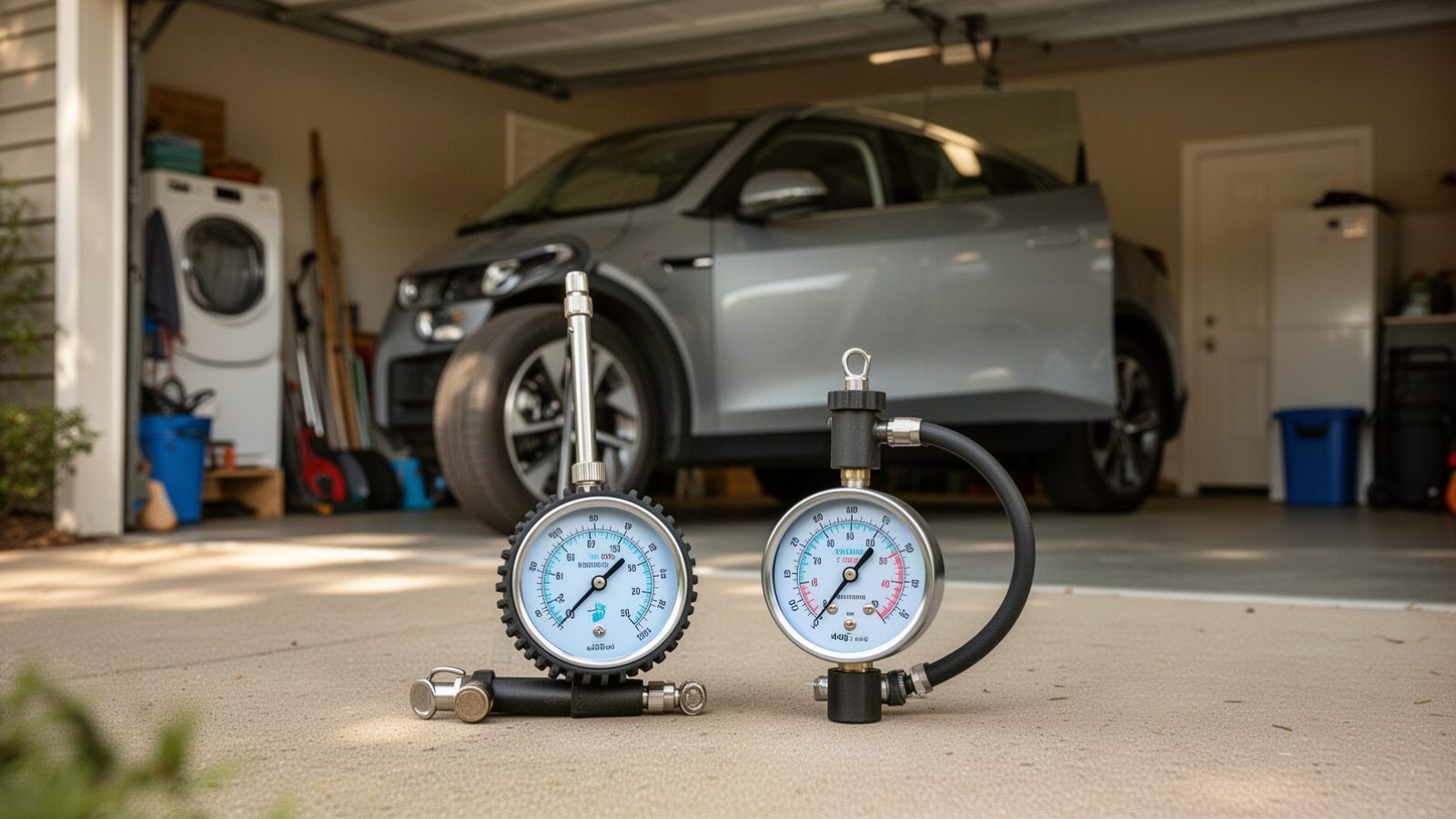
Four reliable tire pressure gauges compared — dial gauges with hoses, a budget digital model and a classic pencil gauge for the glovebox.
As an Amazon Associate I earn from qualifying purchases. When you buy through links on this page, we may earn a commission at no extra cost to you. Learn more
A tire pressure gauge is one of the most affordable and useful tools you can keep in a car. Correct pressure affects braking, handling, tread wear and fuel economy, and tires lose air slowly over time and with falling temperatures. The tire pressure warning light on modern cars helps, but it is designed to warn you when a tire is already well under-inflated, not to keep pressure exactly right.
Gauges come in three basic styles — digital, analog dial and pencil — and the differences that matter are readability, range, a hose for awkward valve stems and a release valve for letting air out. We compared long-running, widely available gauges from JACO, AstroAI, Rhino USA and Milton, and matched each to the kind of driver it suits best. Whichever you choose, use the pressure printed on your vehicle’s door-jamb placard, not the number on the tire sidewall.
Our top picks
-
1
 Illustration
Best overall
JACO ElitePro Tire Pressure Gauge (60 PSI)
Most car, minivan and crossover owners
Gauge typeAnalog dialPressure range0–60 PSI (100 PSI version sold)HoseYes, flexible -
2
 Illustration
Best for trucks and SUVs
Rhino USA Heavy-Duty Tire Pressure Gauge (75 PSI)
Pickup and SUV owners, including those with LT tires
Gauge typeAnalog dial (glow dial)Pressure range0–75 PSIHoseYes, braided -
3
 Illustration
Best digital
AstroAI Digital Tire Pressure Gauge
Drivers who want a large, easy-to-read number
Gauge typeDigital (backlit LCD)Pressure rangeUp to 150 PSIHoseNo, fixed nozzle -
4
 Illustration
Best for the glovebox
Milton S-921 Pencil Tire Gauge
Keeping a backup gauge in every vehicle
Gauge typePencil (sliding scale)Pressure range5–50 PSIHoseNo
JACO ElitePro Tire Pressure Gauge (60 PSI)
Illustration
An analog dial gauge with a flexible hose and a pressure-release valve, sized for passenger-car pressures.
Best for: Most car, minivan and crossover owners- Gauge type
- Analog dial
- Pressure range
- 0–60 PSI (100 PSI version sold)
- Hose
- Yes, flexible
- Release valve
- Yes
- Power
- None needed
What we like
- 0–60 PSI range suits typical passenger-car pressures
- Flexible hose for awkward valve stems
- Release valve for fine adjustments
- No batteries to run flat
Keep in mind
- Bulkier than a pencil gauge
- Dial gauges can lose calibration if dropped hard
- Needs the 100 PSI version for high-pressure LT tires
JACO’s ElitePro is one of the most popular dial gauges for everyday drivers, and the 60 PSI version is well matched to passenger-car tires. Most cars, minivans and crossovers run their tires in the 30s PSI, which falls in the middle of the dial where it is easiest to read.
It has a flexible hose for reaching valve stems behind tight spokes, a pressure-release valve so you can bleed off a little air without removing the gauge, and no batteries to fail when you need it. JACO markets it as calibrated to an ANSI accuracy standard for mechanical gauges.
The trade-offs are typical of dial gauges: it is bulkier than a pencil gauge and should be protected from hard drops. If your truck’s door-jamb placard calls for higher pressures, choose the 100 PSI version or the Rhino USA gauge below.
Bottom line: The easy recommendation for anyone who wants a dependable, easy-to-read gauge for a passenger car.
Rhino USA Heavy-Duty Tire Pressure Gauge (75 PSI)
Illustration
A heavy-duty dial gauge with a 2-inch glow dial, braided hose and brass fittings.
Best for: Pickup and SUV owners, including those with LT tires- Gauge type
- Analog dial (glow dial)
- Pressure range
- 0–75 PSI
- Hose
- Yes, braided
- Release valve
- Yes
- Power
- None needed
What we like
- 75 PSI range covers many LT and SUV tires
- Large glow-in-the-dark dial for night checks
- Braided hose and brass hardware
- Air release valve for quick adjustments
Keep in mind
- Heavier and larger than passenger-car gauges
- Smaller increments are harder to read on a wider scale
- Still may fall short for heavy-duty tires above 75 PSI
Rhino USA’s heavy-duty gauge is built for drivers who want something tougher than a basic dial. It has a large 2-inch glow-in-the-dark dial, a braided hose, solid brass hardware and an air-release valve, and the brand markets it as certified to the ANSI B40.1 accuracy standard for mechanical gauges.
The 0–75 PSI range is the reason to choose it over a 60 PSI gauge. Many pickups and SUVs with light-truck tires specify pressures in the 40s, 50s or higher, especially for towing, and this range keeps those figures comfortably on the dial.
The trade-off is size and resolution: it is bulkier than a car gauge, and the wider range makes small increments a little harder to read. Check your door-jamb placard first — some heavy-duty trucks call for more than 75 PSI.
Bottom line: The pick for pickups and SUVs that need a tough gauge with room on the dial for higher pressures.
AstroAI Digital Tire Pressure Gauge
Illustration
A compact, budget-friendly digital gauge with a backlit screen and a wide pressure range.
Best for: Drivers who want a large, easy-to-read number- Gauge type
- Digital (backlit LCD)
- Pressure range
- Up to 150 PSI
- Hose
- No, fixed nozzle
- Power
- Replaceable batteries
What we like
- Clear digital readout, easy to read at night
- Budget-friendly
- Wide range covers cars, trucks and many bikes
- Small enough for a door pocket
Keep in mind
- Fixed nozzle can be awkward on tight valve stems
- Needs batteries
- Wide range means less of a match for low-pressure precision
AstroAI’s digital gauge is one of the most common budget gauges sold online, and its appeal is simple: press the nozzle to the valve and read a clear number on a backlit screen. There is no needle to interpret, which many drivers find easier, especially at night.
Its wide range, up to 150 PSI, means one gauge covers cars, trucks and many bike tires with Schrader valves. It can also display several pressure units.
The trade-offs are the fixed nozzle, which can be awkward on wheels with tight spokes, and the need for batteries. As with any budget digital gauge, it is worth cross-checking it against a second gauge now and then. Set pressure to the figure on your door-jamb placard for your make, model and year.
Bottom line: A low-cost, easy-to-read gauge for drivers who prefer digits to a dial.
Milton S-921 Pencil Tire Gauge
Illustration
A classic made-in-USA pencil gauge with a 5–50 PSI scale for passenger cars.
Best for: Keeping a backup gauge in every vehicle- Gauge type
- Pencil (sliding scale)
- Pressure range
- 5–50 PSI
- Hose
- No
- Power
- None needed
- Made in
- USA
What we like
- Small enough for a glovebox or pocket
- No batteries and very little to break
- PSI and kPa scales
- Made in the USA by a long-established brand
Keep in mind
- Small scale is harder to read precisely
- Top of the range is too low for many LT tires
- No release valve or hose
Milton has made tire gauges for decades, and the S-921 is its classic passenger-car pencil gauge. It reads 5–50 PSI on a sliding scale, with kPa markings too, and is made in the USA with metal tubing.
The appeal is durability and size. There are no batteries, no screen and almost nothing to break, so it can live in a glovebox for years and still work when you need it. Many drivers keep one in each vehicle as a backup to a nicer dial or digital gauge at home.
The trade-off is readability: a sliding scale with small markings is harder to read precisely than a big dial. The 50 PSI ceiling also rules it out for many light-truck tires. For passenger cars, check the door-jamb pressure for your vehicle and this gauge will cover it.
Bottom line: A nearly indestructible backup gauge that every car glovebox should have.
Side-by-side comparison
| Product | Gauge type | Pressure range | Hose | Release valve | Score |
|---|---|---|---|---|---|
| JACO ElitePro Tire Pressure Gauge (60 PSI)Best overall | Analog dial | 0–60 PSI (100 PSI version sold) | Yes, flexible | Yes | 9.2 |
| Rhino USA Heavy-Duty Tire Pressure Gauge (75 PSI)Best for trucks and SUVs | Analog dial (glow dial) | 0–75 PSI | Yes, braided | Yes | 9.0 |
| AstroAI Digital Tire Pressure GaugeBest digital | Digital (backlit LCD) | Up to 150 PSI | No, fixed nozzle | — | 8.6 |
| Milton S-921 Pencil Tire GaugeBest for the glovebox | Pencil (sliding scale) | 5–50 PSI | No | — | 8.3 |
Specifications are from manufacturer listings at the time of writing and can change between production runs.
Why you need a gauge even with TPMS
US cars built since the late 2000s have a tire pressure monitoring system (TPMS), but it is designed to warn you when a tire is significantly under-inflated — roughly a quarter below the recommended pressure. A few PSI low won’t trigger the light, yet it still affects wear and handling. A monthly check with a gauge catches slow leaks early and lets you set pressure precisely.
Digital, dial or pencil?
- Digital gauges give an easy-to-read number, often with a backlit screen. They need batteries, and cheap ones vary in consistency.
- Analog dial gauges need no batteries and are easy to read at a glance. Better ones add a flexible hose and a pressure-release button.
- Pencil gauges are compact, battery-free and nearly indestructible, but the small sliding scale is harder to read precisely.
Pick the right range
A gauge is easiest to read accurately when your target pressure sits near the middle of its scale. Most passenger cars run somewhere in the 30s PSI, so a 0–60 PSI dial is a good match. Pickups and SUVs with LT tires may call for higher pressures, which suits a 75 or 100 PSI gauge. Check the figure for your make, model and year on the door-jamb placard or in your owner’s manual, including any separate figure for the spare or for heavy loads.
Features worth having
- A flexible hose helps reach valve stems on tight wheels and dual rear wheels.
- A pressure-release valve lets you bleed off excess air without removing the gauge.
- A swivel chuck makes it easier to get a good seal at awkward angles.
- A glow-in-the-dark dial or backlight helps when checking at night.
How to check pressure correctly
Check tires cold — before driving, or after the car has been parked for a few hours. Press the chuck squarely onto the valve stem so you don’t hear air escaping, read the gauge, and add or release air as needed. Don’t forget the spare if your vehicle has one. Recheck when temperatures drop sharply, since pressure falls in cold weather.
Frequently asked questions
What tire pressure should I use?
Use the cold pressure on the placard inside the driver’s door jamb or in your owner’s manual for your make, model and year. The number molded on the tire sidewall is the maximum the tire can hold, not the recommended pressure.
Are digital tire gauges more accurate than dial gauges?
Not necessarily. A good dial gauge and a good digital gauge can both be accurate; digital gauges are simply easier to read. What matters more is buying a reputable gauge and keeping it protected from drops.
How often should I check tire pressure?
At least once a month and before long trips, with the tires cold. Check more often in fall and winter, when falling temperatures lower tire pressure.
Can I check pressure right after driving?
You can, but the reading will be higher than the cold figure on your door jamb. For accurate results, wait until the tires have cooled for a few hours.
Do these gauges work on bicycle tires?
They fit Schrader valves, which are used on cars and many bikes. Bikes with Presta valves need an adapter, and road-bike pressures can exceed the range of a 60 PSI gauge.
How we picked
We compared gauge type, pressure range, readability, hose and release-valve features, build materials and how long each model has been sold, using manufacturer information and published specifications. Our picks and scores are based on this research — we have not tested these products hands-on. Brands cannot pay to be included. Read our full method.