






















The best OLED TVs
Six OLED TV series compared, from LG's value B-Series to Samsung's anti-glare S95 — with plain advice on panel types, sizes, brightness and gaming features.
As an Amazon Associate I earn from qualifying purchases. When you buy through links on this page, we may earn a commission at no extra cost to you. Learn more
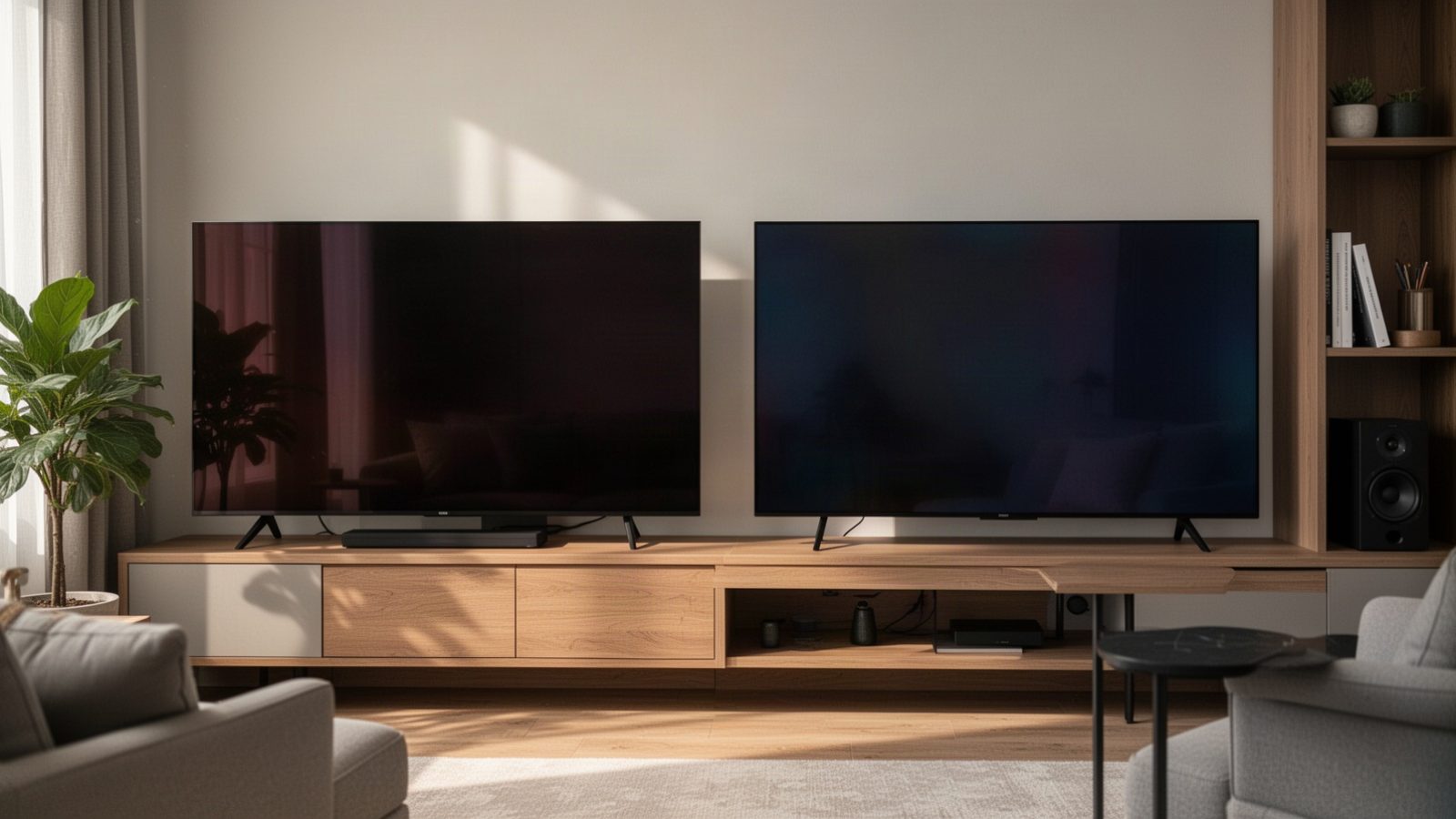
OLED TVs have no backlight. Every pixel makes its own light and can switch completely off, so black is truly black, contrast is effectively perfect and there is no glow or blooming around bright objects on a dark background. Viewing angles are wide, motion looks clean and the slim panels look great on a wall. The trade-offs are that OLEDs usually can't match the full-screen brightness of the best mini-LED TVs, and they cost more per inch.
Almost every OLED TV uses one of two panel types: LG Display's WOLED or Samsung Display's QD-OLED. What really separates the models is the brightness tier, picture processing, smart platform, HDR support, gaming features and the size range on offer. We compared the main OLED series from LG, Samsung and Sony on those points and picked the best one for different rooms, budgets and viewers.
Our top picks
-
1
 Illustration
Best overall
LG C-Series OLED evo 4K TV
Most living rooms, movie nights and gaming
PanelWOLED (OLED evo)Smart platformwebOSSizes42–83 inches -
2
 Illustration
Best for movie lovers
Sony Bravia 8 II QD-OLED TV
Film fans who value natural, accurate picture processing
PanelQD-OLEDSmart platformGoogle TVSizes55 and 65 inches -
3
 Illustration
Best premium
LG G-Series OLED evo Gallery TV
Bright rooms and wall-mounted living rooms
PanelWOLED (brighter OLED evo tier)Smart platformwebOSSizes55–97 inches (varies by year) -
4
 Illustration
Best for bright rooms
Samsung S95 Series QD-OLED TV
Rooms with windows and lamps that cause glare
PanelQD-OLED, matte anti-glare finishSmart platformTizenSizes55–83 inches (varies by year) -
5
 Illustration
Best for gamers
Samsung S90 Series OLED TV
Console and PC gamers in Samsung households
PanelQD-OLED or WOLED, depending on sizeSmart platformTizenSizes42–83 inches -
6
 Illustration
Best value
LG B-Series OLED 4K TV
Getting OLED contrast for the least money
PanelWOLEDSmart platformwebOSSizes48–83 inches (varies by year)
LG C-Series OLED evo 4K TV
Illustration
LG's mid-range OLED balances strong brightness, a full set of gaming features and the widest choice of sizes.
Best for: Most living rooms, movie nights and gaming- Panel
- WOLED (OLED evo)
- Smart platform
- webOS
- Sizes
- 42–83 inches
- HDR formats
- Dolby Vision, HDR10, HLG
- Gaming
- 4K 120Hz or higher, VRR, four HDMI 2.1 ports
What we like
- Perfect blacks and wide viewing angles
- Four HDMI 2.1 ports with high refresh rates and VRR
- Sizes from compact 42-inch to 83-inch
- Supports Dolby Vision
Keep in mind
- Not as bright as flagship OLEDs in a sunny room
- Glossy screen shows reflections
- Built-in speakers are thin, like most slim TVs
The C-Series has been the default OLED recommendation for years, and for good reason. It delivers the core OLED strengths — inky blacks, pinpoint highlights and wide viewing angles — with enough brightness for most living rooms and a feature list that covers nearly everything.
Gamers are especially well served. All four HDMI ports are HDMI 2.1, so a console, a gaming PC and a soundbar can share the TV without juggling inputs, and recent versions run above 120Hz with variable refresh rate. LG's webOS is quick, and Dolby Vision support means streaming services can send their best HDR versions.
The size range is a quiet advantage: the 42- and 48-inch versions suit bedrooms and desks, while the 77- and 83-inch models fill a home theater. If your room gets a lot of direct sun, a brighter flagship is worth considering.
Bottom line: The OLED to buy if you want excellent picture quality and complete gaming features without paying flagship prices.
Sony Bravia 8 II QD-OLED TV
Illustration
Sony's QD-OLED pairs a bright, colorful panel with the brand's well-regarded processing and the Google TV platform.
Best for: Film fans who value natural, accurate picture processing- Panel
- QD-OLED
- Smart platform
- Google TV
- Sizes
- 55 and 65 inches
- HDR formats
- Dolby Vision, HDR10, HLG
- Gaming
- 4K 120Hz, VRR
What we like
- Rich, vivid color from the QD-OLED panel
- Natural-looking motion and upscaling
- Google TV with Chromecast and voice search built in
- Sound comes from the screen itself for clear dialogue
Keep in mind
- Only 55- and 65-inch sizes
- Premium-priced for its size
- Fewer full-bandwidth HDMI 2.1 ports than LG's C-Series
Sony's strength has always been processing — the behind-the-scenes work of upscaling, smoothing gradients and handling motion so that films look natural rather than overcooked. The Bravia 8 II combines that with a QD-OLED panel, which gives bright, saturated colors and the perfect black levels you expect from OLED.
Sound comes from actuators that vibrate the screen itself, so voices appear to come from the actors rather than from the bottom edge of the TV. Google TV makes it easy to find streaming apps, and Chromecast is built in.
The catches are size and price. You can only choose 55 or 65 inches, and it costs more than LG's C-Series at the same size. Gamers will also find fewer full HDMI 2.1 ports than on LG and Samsung models.
Bottom line: A superb choice for movie fans with a 55- or 65-inch space who care most about natural, cinematic picture quality.
LG G-Series OLED evo Gallery TV
Illustration
LG's flagship OLED is brighter than the C-Series and built to hang flush on the wall like a picture frame.
Best for: Bright rooms and wall-mounted living rooms- Panel
- WOLED (brighter OLED evo tier)
- Smart platform
- webOS
- Sizes
- 55–97 inches (varies by year)
- HDR formats
- Dolby Vision, HDR10, HLG
- Gaming
- 4K 120Hz or higher, VRR, four HDMI 2.1 ports
What we like
- Noticeably brighter than LG's mid-range OLED
- Slim gallery design sits flush against the wall
- Four HDMI 2.1 ports
- Available in very large sizes
Keep in mind
- Premium-priced
- Designed for the wall, so a table stand may be sold separately in some sizes
- Extra brightness matters less in a dark room
The G-Series is LG's answer to the main complaint about OLED: brightness. Each recent generation has pushed its highlights and full-screen brightness above the C-Series, so HDR looks punchier and the picture holds up better in a room with daylight.
It is also a design piece. The ultra-slim body is made to mount flush on the wall, so it looks like a framed picture rather than a TV hanging off a bracket. Check whether your size includes a stand if you plan to put it on furniture.
Everything else that makes the C-Series a strong all-rounder carries over: four HDMI 2.1 ports, high refresh rates for gaming, Dolby Vision and webOS. If you watch mostly at night with the lights down, the C-Series gives you most of the experience for less.
Bottom line: Worth the premium if your room is bright or you want a TV that looks built into the wall.
Samsung S95 Series QD-OLED TV
Illustration
Samsung's flagship QD-OLED adds a matte anti-glare finish that tames reflections better than glossy OLED screens.
Best for: Rooms with windows and lamps that cause glare- Panel
- QD-OLED, matte anti-glare finish
- Smart platform
- Tizen
- Sizes
- 55–83 inches (varies by year)
- HDR formats
- HDR10, HDR10+, HLG (no Dolby Vision)
- Gaming
- 4K 144Hz or higher, VRR
What we like
- Matte screen dramatically reduces reflections
- Very bright, vivid HDR color
- High refresh rate suits PC gaming
- Samsung Gaming Hub streams games without a console
Keep in mind
- No Dolby Vision support
- Under direct light, the matte finish can make blacks look slightly gray
- Premium-priced
Glossy OLED screens can act like mirrors in a sunny room. Samsung's S95 series tackles that with a matte anti-glare treatment that diffuses reflections from windows and lamps, so you see the picture instead of the room behind you.
Underneath is a bright QD-OLED panel with rich color and the usual OLED contrast. It supports very high refresh rates for PC gaming, and Samsung Gaming Hub lets you stream games from cloud services with just a controller.
There are trade-offs. Samsung doesn't support Dolby Vision, relying on HDR10+ instead, and when strong light falls directly on the matte screen, blacks can look a touch lifted. In a dark home theater, a glossy flagship looks slightly deeper. But for a family room full of daylight, few OLEDs are easier to watch.
Bottom line: The OLED to get if glare is your biggest problem and you can live without Dolby Vision.
Samsung S90 Series OLED TV
Illustration
Samsung's mid-range OLED offers high refresh rates, strong gaming tools and a wide size range for less than the S95.
Best for: Console and PC gamers in Samsung households- Panel
- QD-OLED or WOLED, depending on size
- Smart platform
- Tizen
- Sizes
- 42–83 inches
- HDR formats
- HDR10, HDR10+, HLG (no Dolby Vision)
- Gaming
- 4K 120Hz or higher, VRR, Game Bar
What we like
- High refresh rates and VRR on most sizes
- Game Bar overlay and Gaming Hub cloud streaming
- Wide size range from 42 to 83 inches
- Works smoothly with Samsung phones and SmartThings
Keep in mind
- No Dolby Vision support
- Panel type varies by size, so picture can differ slightly
- Glossy screen is more reflective than the S95
The S90 series is Samsung's answer to LG's C-Series, and it is especially appealing to gamers. Most sizes support refresh rates above 120Hz with variable refresh rate, and Samsung's Game Bar puts frame rate, input lag and picture settings in one quick overlay. Gaming Hub adds cloud game streaming with no console required.
One quirk: depending on screen size and production run, the S90 may use a QD-OLED or a WOLED panel. Both look excellent, but picture character can differ slightly, so it's worth knowing before comparing reviews of a specific size.
Like all Samsung TVs, it skips Dolby Vision. If you already use a Samsung phone or SmartThings at home, though, the integration is convenient, and the S90 is frequently priced below LG's C-Series.
Bottom line: A strong, frequently well-priced OLED for gamers who don't need Dolby Vision.
LG B-Series OLED 4K TV
Illustration
LG's entry OLED delivers the perfect blacks and viewing angles of its pricier siblings with a dimmer panel and simpler processing.
Best for: Getting OLED contrast for the least money- Panel
- WOLED
- Smart platform
- webOS
- Sizes
- 48–83 inches (varies by year)
- HDR formats
- Dolby Vision, HDR10, HLG
- Gaming
- 4K 120Hz, VRR
What we like
- Same perfect blacks as more expensive OLEDs
- Dolby Vision and 4K 120Hz gaming support
- Often priced close to premium LED TVs
- A 48-inch size suits bedrooms and desks
Keep in mind
- Dimmer than the C-Series, so better for darker rooms
- Simpler processor with less refined upscaling
- Fewer premium extras
The B-Series is the most affordable way into LG's OLED lineup, and in a dim room it delivers most of what makes OLED special: true blacks, no blooming around subtitles and excellent viewing angles for wide sofas.
The savings come from a dimmer panel and a simpler processor. HDR highlights won't pop as much as on the C- or G-Series, and the picture is less impressive in a bright, sunny room. Upscaling of lower-quality sources is also a step behind.
For movie nights with the lights down, casual gaming and everyday streaming, those differences are modest. You still get webOS, Dolby Vision and 4K 120Hz gaming support, which makes the B-Series an easy recommendation if you want OLED contrast without paying for brightness you may not need.
Bottom line: The smart buy for darker rooms if you want OLED picture quality at the lowest step up.
Side-by-side comparison
| Product | Panel | Smart platform | Sizes | HDR formats | Score |
|---|---|---|---|---|---|
| LG C-Series OLED evo 4K TVBest overall | WOLED (OLED evo) | webOS | 42–83 inches | Dolby Vision, HDR10, HLG | 9.4 |
| Sony Bravia 8 II QD-OLED TVBest for movie lovers | QD-OLED | Google TV | 55 and 65 inches | Dolby Vision, HDR10, HLG | 9.2 |
| LG G-Series OLED evo Gallery TVBest premium | WOLED (brighter OLED evo tier) | webOS | 55–97 inches (varies by year) | Dolby Vision, HDR10, HLG | 9.1 |
| Samsung S95 Series QD-OLED TVBest for bright rooms | QD-OLED, matte anti-glare finish | Tizen | 55–83 inches (varies by year) | HDR10, HDR10+, HLG (no Dolby Vision) | 9.0 |
| Samsung S90 Series OLED TVBest for gamers | QD-OLED or WOLED, depending on size | Tizen | 42–83 inches | HDR10, HDR10+, HLG (no Dolby Vision) | 8.9 |
| LG B-Series OLED 4K TVBest value | WOLED | webOS | 48–83 inches (varies by year) | Dolby Vision, HDR10, HLG | 8.7 |
Specifications are from manufacturer listings at the time of writing and can change between production runs.
WOLED or QD-OLED?
WOLED panels, used in LG's own TVs and some Samsung sizes, are the long-proven design and come in the widest range of sizes, from small 42-inch sets to giant screens. QD-OLED panels, used in Samsung's S95 series, many S90 sizes and Sony's Bravia 8 II, add a quantum-dot layer that helps bright, saturated colors look especially rich.
Both look excellent in a dim room. In practice, the brightness tier of a series matters more than which panel it uses.
Entry, middle or flagship?
Each brand sells OLED in tiers, and every tier gets the same perfect blacks:
- Entry (LG B-Series): dimmer and with simpler processing, but still a big step up from most LED TVs in a dark room.
- Middle (LG C-Series, Samsung S90): the sweet spot for most people, with brighter pictures and full gaming features.
- Flagship (LG G-Series, Samsung S95, Sony Bravia 8 II): noticeably brighter and better at handling reflections, which matters most in rooms with windows.
Each series is refreshed roughly once a year. Last year's version often stays on sale next to the new one for less money, and because yearly improvements are usually modest, it is often the smarter buy.
What size should you buy?
As a rough guide for 4K, sitting around 6 feet away suits a 55-inch screen, around 8 feet suits 65 inches, and 9 feet or more suits 77 inches and up. If you are torn between two sizes, the larger one is rarely a regret. The 42- and 48-inch OLEDs make excellent bedroom TVs and big gaming monitors. Before ordering a large screen, check that your stand or wall can take its width and weight.
Features worth paying for
- HDMI 2.1 with 4K at 120Hz and VRR if you own a PS5, Xbox Series X or gaming PC. Count the ports if you have several devices.
- Dolby Vision is supported by LG and Sony. Samsung skips it and uses HDR10+ instead, which matters if you watch a lot of Dolby Vision content on streaming services.
- Anti-glare screens such as Samsung's matte S95 finish cut reflections in bright rooms.
- A good soundbar budget. Slim OLEDs have little room for speakers, so plan on adding one.
Burn-in, care and what to skip
Modern OLEDs use pixel shifting and automatic refresh cycles to reduce the risk of burn-in. With varied viewing — movies, shows, sports and games — it is rarely a problem. Heavy use with static images, such as a news channel with a fixed ticker for many hours a day, carries more risk, so check the warranty terms if that's you. Leave the TV plugged in on standby so it can run its maintenance cycles.
Skip extended "screen protection" plans sold as burn-in insurance without reading what they cover, and don't pay extra for 8K. Clean the screen with a dry microfiber cloth only, never spray cleaner directly on the panel.
Frequently asked questions
Is burn-in still a problem with OLED TVs?
It is much less of a concern than it used to be. Current OLEDs shift pixels and run refresh cycles in standby to even out wear. Burn-in risk mainly comes from showing the same static image for many hours every day, such as a news ticker or a PC desktop.
Is OLED or mini-LED better?
OLED has perfect blacks, wider viewing angles and no blooming, which makes it ideal for movies in a dim room. Mini-LED TVs get brighter across the whole screen and cost less at big sizes, which suits sunny rooms and very large screens.
Do Samsung OLED TVs support Dolby Vision?
No. Samsung TVs support HDR10, HDR10+ and HLG but not Dolby Vision. Content mastered in Dolby Vision still plays, using the HDR10 base layer. LG and Sony OLEDs support Dolby Vision.
Should I buy last year's OLED model?
Often, yes. Year-to-year changes within a series are usually small, and the previous model tends to be noticeably less expensive while it is still in stock. Check that it has the sizes and HDMI features you need.
Are OLED TVs good for gaming?
Very good. Mid-range and flagship OLEDs support 4K at 120Hz or higher, variable refresh rate and very low input lag, and the near-instant pixel response keeps fast motion clear.
How we picked
We compared manufacturer specifications for each OLED series — panel type, size range, HDR formats, HDMI 2.1 and gaming features, smart platform and anti-glare treatment — and looked at how each series has been positioned across recent model years. We then weighed how each suits bright living rooms, dark home theaters and gaming setups. Our picks and scores are based on this research — we have not tested these products hands-on. Brands cannot pay to be included. Read our full method.