






















The best digital kitchen scales
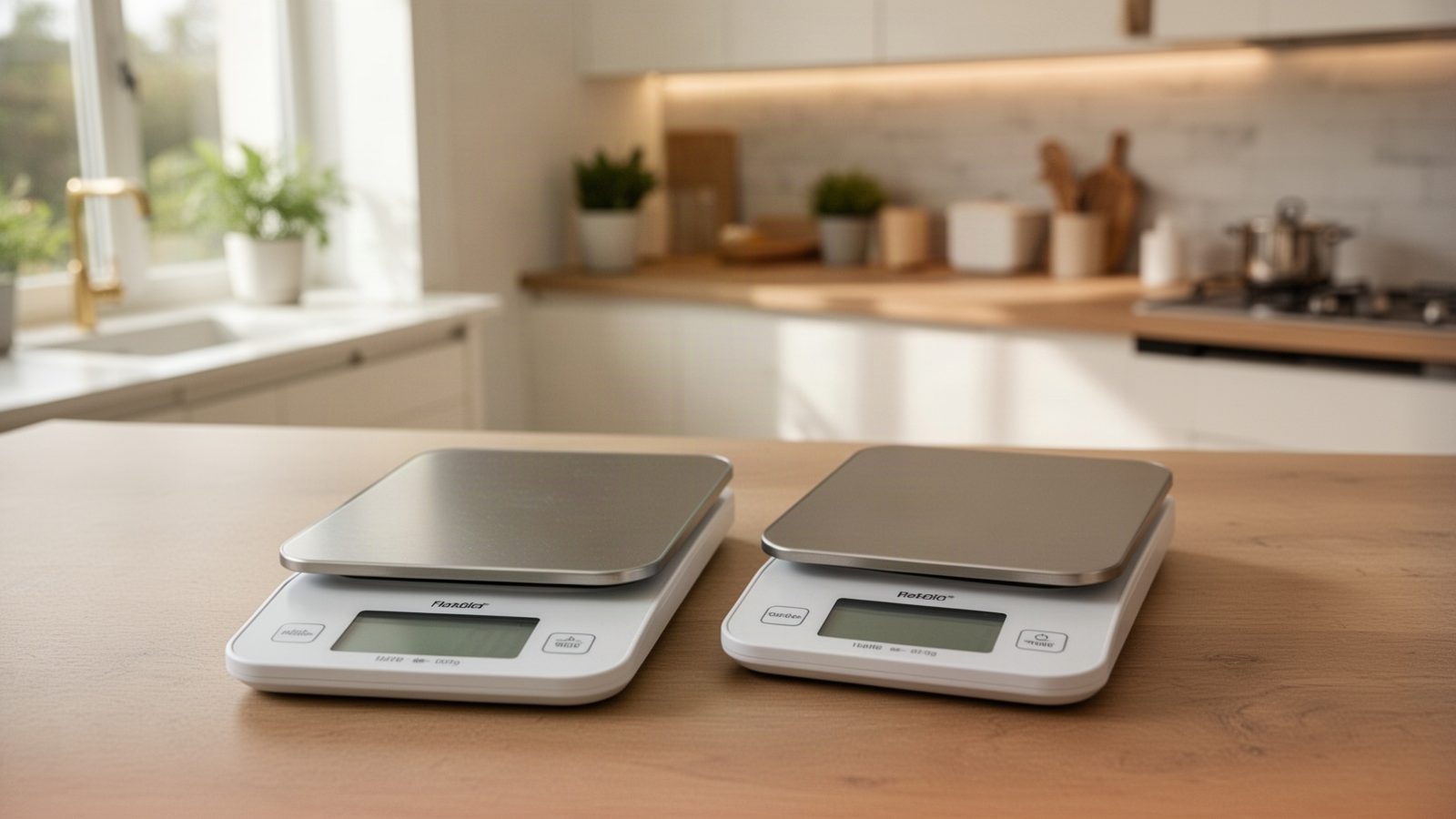
Five digital kitchen scales compared — a compact everyday favorite, a pull-out display for big bowls, a baker’s-percentage scale for bread and a 0.1-gram coffee scale.
As an Amazon Associate I earn from qualifying purchases. When you buy through links on this page, we may earn a commission at no extra cost to you. Learn more
Weighing ingredients is the easiest way to make baking more consistent. A cup of flour can vary by a surprising amount depending on how it is scooped, but 125 grams is always 125 grams. A digital scale also means fewer measuring cups to wash: set the bowl on the scale, press tare, and add each ingredient in turn.
Scales are useful well beyond baking — portioning burgers, dividing dough, weighing coffee beans, scaling recipes up or down, or checking package sizes. The best ones are accurate, quick to respond, easy to clean and simple enough that you actually use them. We compared long-running scales from established brands and picked the best for everyday cooking, large bowls, serious bread baking, pour-over coffee and tight budgets.
Our top picks
-
1
 Illustration
Best overall
Escali Primo Digital Kitchen Scale
Everyday cooking and baking
Capacity11 lb (5 kg)Increments0.1 oz / 1 gStandout featureSimple two-button design -
2
 Illustration
Best for large bowls
OXO Good Grips 11-Pound Scale with Pull-Out Display
Bakers using big mixing bowls
Capacity11 lb (5 kg)Increments1/8 oz / 1 gStandout featurePull-out, backlit display -
3
 Illustration
Best for bread bakers
My Weigh KD-8000 Baker’s Scale
Sourdough and large-batch baking
Capacity8,000 g (about 17.6 lb)Increments1 gStandout featureBaker’s percentage mode -
4
 Illustration
Best for coffee
Hario V60 Drip Scale
Pour-over coffee and small precise measurements
Capacity2 kg (about 4.4 lb)Increments0.1 g at low weightsStandout featureBuilt-in brew timer -
5
 Illustration
Best budget
Etekcity Stainless Steel Digital Kitchen Scale
Starting to weigh ingredients without spending much
Capacity11 lb (5 kg)Increments1 gStandout featureSlim stainless platform
Escali Primo Digital Kitchen Scale
Illustration
A compact, simple 11-pound scale with sealed buttons that has been a kitchen favorite for years.
Best for: Everyday cooking and baking- Capacity
- 11 lb (5 kg)
- Increments
- 0.1 oz / 1 g
- Standout feature
- Simple two-button design
- Units
- Grams, ounces, pounds
What we like
- Simple, intuitive two-button operation
- Compact footprint stores easily
- Sealed design is easy to wipe clean
- Available in many colors
Keep in mind
- Large bowls can shade the display
- No backlight
- Auto-off can interrupt slow recipes
The Escali Primo has been one of the most recommended kitchen scales for years because it gets the basics right without fuss. It weighs up to 11 pounds in 1-gram steps, has just two buttons — power/tare and units — and is small enough to live on the counter or slide into a drawer.
The sealed buttons and smooth top make it easy to wipe down after flour or batter spills. It also comes in a wide range of colors, which is a nice touch for something you may leave out.
The compromises are minor. A very wide bowl can cover the display, there is no backlight, and the scale switches off after a few minutes of inactivity. For most home cooks, none of that outweighs its simplicity and reliability.
Bottom line: The best all-round kitchen scale for most people: simple, compact and dependable.
OXO Good Grips 11-Pound Scale with Pull-Out Display
Illustration
An 11-pound stainless steel scale whose backlit display pulls away from the base so big bowls never hide it.
Best for: Bakers using big mixing bowls- Capacity
- 11 lb (5 kg)
- Increments
- 1/8 oz / 1 g
- Standout feature
- Pull-out, backlit display
- Platform
- Removable stainless steel
What we like
- Pull-out display stays visible under wide bowls
- Backlit screen is easy to read
- Removable stainless platform for cleaning
- Sturdy, stable build
Keep in mind
- Larger than compact scales
- Premium-priced for an 11-pound scale
- Ounce readings in 1/8 oz steps rather than decimals
The most common frustration with kitchen scales is a big bowl hiding the numbers. OXO’s answer is clever: the backlit display slides out from the base on a short tether, so you can read it clearly no matter what is on the platform.
Beyond that, it is a solid 11-pound scale with 1-gram resolution, a stainless steel platform that lifts off for washing, and a stable base that doesn’t slide around on the counter. It is a natural match for bakers who mix bread dough or big cake batters in wide bowls.
It is larger and costs more than compact scales like the Escali, and it shows ounces in eighths rather than decimals. If you weigh in grams, that won’t matter.
Bottom line: The best pick if your mixing bowls usually hide the display on other scales.
My Weigh KD-8000 Baker’s Scale
Illustration
An 8-kilogram scale with a baker’s percentage mode, a removable platform and an optional AC adapter.
Best for: Sourdough and large-batch baking- Capacity
- 8,000 g (about 17.6 lb)
- Increments
- 1 g
- Standout feature
- Baker’s percentage mode
- Power
- Batteries or included AC adapter
What we like
- High capacity for big doughs and heavy bowls
- Baker’s percentage mode simplifies bread formulas
- Removable stainless platform and display cover
- Can run from an AC adapter
Keep in mind
- Bulkier than everyday scales
- More buttons and modes to learn
- Overkill for casual cooking
The KD-8000 has a loyal following among bread bakers, and its features explain why. It handles up to 8 kilograms in 1-gram steps, so you can weigh a heavy stand-mixer bowl full of dough without worrying about capacity.
Its standout feature is a baker’s percentage mode. Bread formulas are often written as percentages of flour weight, and the scale can calculate the other ingredients for you. It also has a removable stainless steel platform and a cover that protects the display from flour and splashes.
It can run on batteries or the included AC adapter, handy for long baking sessions. The trade-off is size and complexity: casual cooks will find a simpler scale easier to live with.
Bottom line: The scale to get if you bake bread seriously or work with large batches.
Hario V60 Drip Scale
Illustration
A slim coffee scale with 0.1-gram resolution at low weights and a built-in brew timer.
Best for: Pour-over coffee and small precise measurements- Capacity
- 2 kg (about 4.4 lb)
- Increments
- 0.1 g at low weights
- Standout feature
- Built-in brew timer
- Power
- 2 AAA batteries
What we like
- Fine resolution for coffee, tea and spices
- Timer runs alongside the weight readout
- Slim enough to fit under a brewer
- From a long-established coffee-gear brand
Keep in mind
- Lower capacity than kitchen scales
- Too small for big mixing bowls
Hario’s V60 Drip Scale was designed for pour-over coffee, where tracking both the weight of water and the time it takes to pour makes a real difference in the cup. It shows weight and a running timer side by side, and it reads in 0.1-gram steps at low weights.
That precision also makes it handy in the kitchen for small quantities: yeast, salt, baking soda, spices and loose-leaf tea, where a single gram matters. The low profile fits under most drippers.
Its 2-kilogram capacity and compact platform make it a poor fit for big mixing bowls, so think of it as a companion to a regular kitchen scale rather than a replacement.
Bottom line: A precise, compact scale for coffee lovers that also handles small baking measurements.
Etekcity Stainless Steel Digital Kitchen Scale
Illustration
A slim, budget-friendly 11-pound scale with a stainless steel platform and simple controls.
Best for: Starting to weigh ingredients without spending much- Capacity
- 11 lb (5 kg)
- Increments
- 1 g
- Standout feature
- Slim stainless platform
- Power
- 2 AAA batteries
What we like
- Very budget-friendly
- Thin profile stores anywhere
- Stainless platform wipes clean
- Simple tare and unit buttons
Keep in mind
- Display can be hidden by wide bowls
- Less proven over many years than Escali or OXO
- Lightweight build
Etekcity is one of the most widely sold scale brands, and its stainless steel kitchen scale is a low-cost way to start baking by weight. It weighs up to 11 pounds in 1-gram steps, has a thin stainless platform that wipes clean, and uses straightforward tare and unit buttons.
For basic tasks — weighing flour and sugar, portioning meat, checking coffee beans — it covers the essentials. Its slim body slides into a drawer or stands on its side in a cabinet.
The trade-offs are the usual ones at this level: a lighter build, a display that wide bowls can block, and less of a long-term track record than our top picks. If you are not sure how often you will use a scale, it is a sensible place to start.
Bottom line: A low-cost, no-fuss way to start weighing ingredients.
Side-by-side comparison
| Product | Capacity | Increments | Standout feature | Units | Score |
|---|---|---|---|---|---|
| Escali Primo Digital Kitchen ScaleBest overall | 11 lb (5 kg) | 0.1 oz / 1 g | Simple two-button design | Grams, ounces, pounds | 9.2 |
| OXO Good Grips 11-Pound Scale with Pull-Out DisplayBest for large bowls | 11 lb (5 kg) | 1/8 oz / 1 g | Pull-out, backlit display | — | 9.0 |
| My Weigh KD-8000 Baker’s ScaleBest for bread bakers | 8,000 g (about 17.6 lb) | 1 g | Baker’s percentage mode | — | 8.8 |
| Hario V60 Drip ScaleBest for coffee | 2 kg (about 4.4 lb) | 0.1 g at low weights | Built-in brew timer | — | 8.5 |
| Etekcity Stainless Steel Digital Kitchen ScaleBest budget | 11 lb (5 kg) | 1 g | Slim stainless platform | — | 8.3 |
Specifications are from manufacturer listings at the time of writing and can change between production runs.
Capacity and increments
Most kitchen scales weigh up to about 11 pounds (5 kilograms) in 1-gram steps, which covers almost all home cooking and baking. Bread bakers who mix large batches in heavy bowls may want more capacity. For coffee, tea, spices and leaveners, a scale that reads in 0.1-gram steps is more useful, though those usually have a lower maximum.
Remember that the weight of your bowl counts toward the capacity, so a heavy stand-mixer bowl or ceramic bowl eats into it.
Features that make a difference
- Tare (zero) button: lets you reset to zero after adding the bowl or each ingredient. Every decent scale has one.
- Readable display: large bowls can shade a fixed display; a pull-out or raised screen solves that. A backlight helps too.
- Grams and ounces: grams are easier for baking because there are no fractions.
- Auto-off delay: some scales switch off quickly to save battery, which can be annoying in the middle of a recipe.
- Easy cleaning: a flat stainless or glass platform and sealed buttons wipe clean; removable platforms are even easier.
Baker’s percentage and other modes
Bread recipes are often written as percentages of the flour weight. Scales with a baker’s percentage mode do that math for you. Coffee scales add a built-in timer for timing pour-over brews. These are worth having only if you do those things often.
What to skip
Scales with apps, nutrition databases and color screens look appealing, but most people use a scale for weighing and taring. Simple, sturdy scales tend to last longer.
Batteries and power
Most kitchen scales run on AAA, AA or coin-cell batteries, which typically last months with regular use. Keep a spare set in the drawer, since a low battery can cause readings to drift before the display warns you. Scales that also accept an AC adapter are handy for long bread-baking sessions, and some coffee scales now charge over USB instead.
Care tips
Wipe the platform with a damp cloth; never submerge the scale. Don’t store heavy pans on top of it, which can strain the load cell. Use it on a flat, hard surface, and replace the batteries when readings start to drift or the display dims.
Frequently asked questions
Why should I weigh ingredients instead of using cups?
Weight is more consistent than volume. Flour, sugar and other dry ingredients can pack differently each time you scoop them, which changes how much you actually add. Weighing gives repeatable results and means fewer dishes.
What does the tare button do?
Tare resets the display to zero with something already on the scale. Put your bowl on, press tare, add an ingredient, press tare again, and add the next one — all in the same bowl.
Do I need a scale that reads in 0.1 grams?
For most cooking and baking, 1-gram steps are enough. A 0.1-gram scale helps with pour-over coffee, tea, spices, yeast and baking soda in small batches, where a gram makes a noticeable difference.
How do I know if my kitchen scale is accurate?
Weigh something with a known weight, such as a sealed package or coins of known weight, and compare. If readings drift, replace the batteries and make sure the scale is on a flat, hard surface.
Can I weigh liquids on a kitchen scale?
Yes. Water weighs about 1 gram per milliliter, so many scales are perfect for measuring water for bread or coffee. Other liquids such as milk and oil differ slightly, so follow the recipe’s weights.
How we picked
We compared capacities, increments, display designs, cleaning features, power options and special modes for long-running digital kitchen scales from established brands sold online, and considered how each suits everyday cooking, baking, bread making and coffee. Our picks and scores are based on this research — we have not tested these products hands-on. Brands cannot pay to be included. Read our full method.