






















The best dehumidifiers
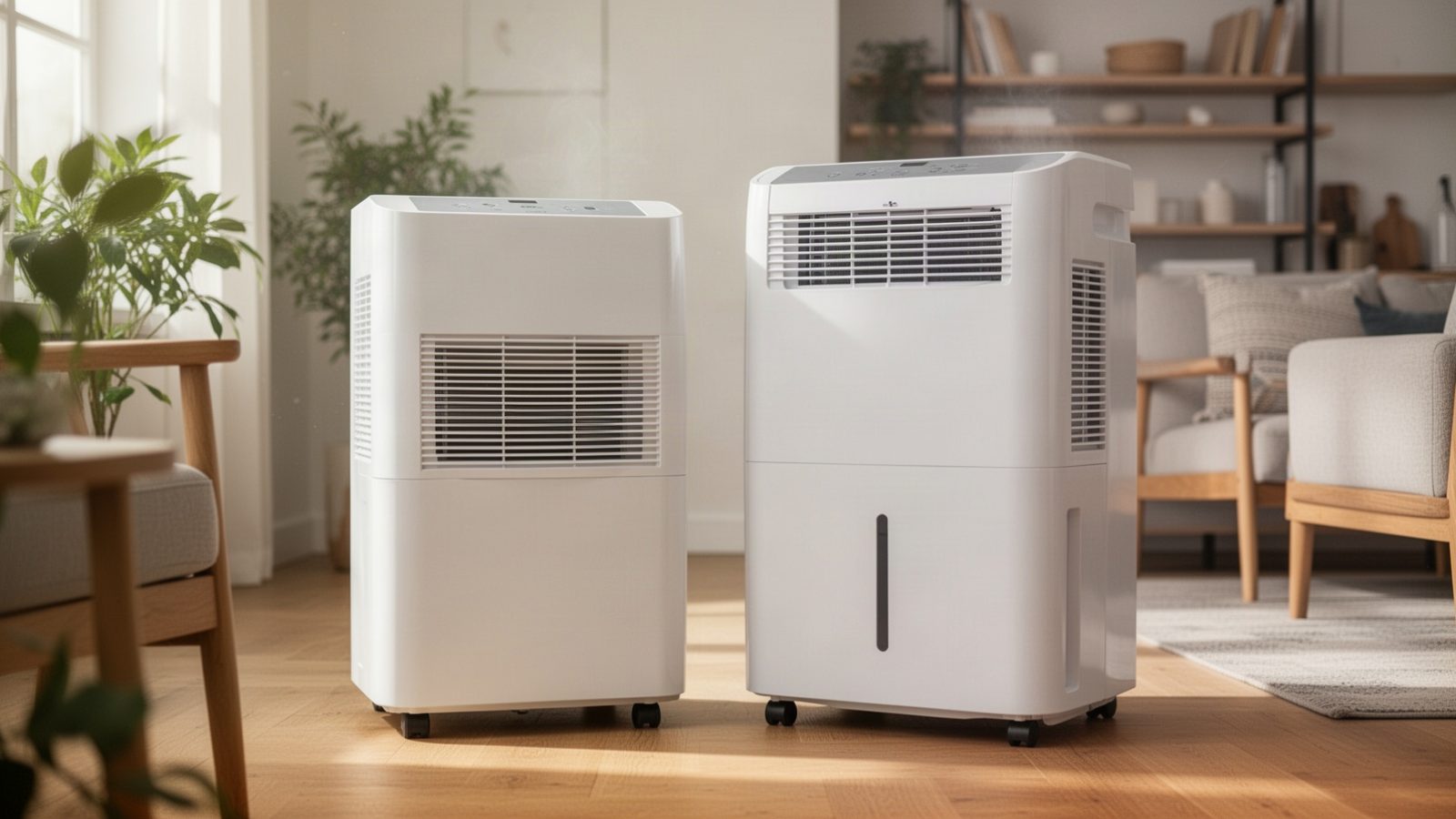
Five dehumidifiers compared — 50-pint models for basements and damp rooms, a crawlspace unit and a cordless mini dehumidifier for closets and cabinets.
As an Amazon Associate I earn from qualifying purchases. When you buy through links on this page, we may earn a commission at no extra cost to you. Learn more
A damp basement, a musty laundry room or windows streaming with condensation all point to the same problem: too much moisture in the air. A dehumidifier pulls that moisture out and collects it in a bucket or sends it down a drain, helping protect stored belongings, wood, drywall and anything else that suffers in persistently humid conditions.
Capacity is the headline number, but it is easy to misread, because the industry changed how it measures dehumidifiers in 2019 and many older ratings look bigger than newer ones. Drainage options, noise and how easy the filter and bucket are to deal with matter just as much day to day. We compared capacity ratings, drainage, controls, efficiency certifications and maintenance needs for long-running dehumidifiers from established brands.
Our top picks
-
1
 Illustration
Best overall
Midea Cube 50-Pint Dehumidifier
Basements and large damp rooms
Capacity50 pints/dayTypeCompressorDrain optionsBucket or continuous drain hose -
2
 Illustration
Best traditional design
Frigidaire 50-Pint Dehumidifier
Basements, laundry rooms and damp storage areas
Capacity50 pints/dayTypeCompressorDrain optionsBucket or continuous drain hose -
3
 Illustration
Best value
hOmeLabs 50-Pint Energy Star Dehumidifier
Damp basements on a budget
Capacity50 pints/dayTypeCompressorDrain optionsBucket or continuous drain hose -
4
 Illustration
Best for crawlspaces
Aprilaire E070 Pro Dehumidifier
Crawlspaces and unfinished basements
Capacity70 pints/dayTypeCompressor, heavy-dutyDrain optionsDrain hose (no bucket) -
5
 Illustration
Best for closets
Eva-dry E-333 Renewable Mini Dehumidifier
Closets, cabinets, gun safes and RVs
CapacitySmall (absorbs ounces, not pints)TypeDesiccant, cordlessDrain optionsNone; plug in to dry and reuse
Midea Cube 50-Pint Dehumidifier
Illustration
A compact, cube-shaped compressor dehumidifier whose water tank fits inside the unit for storage, with a humidistat and continuous drain option.
Best for: Basements and large damp rooms- Capacity
- 50 pints/day
- Type
- Compressor
- Drain options
- Bucket or continuous drain hose
- Controls
- Humidistat; app control on smart versions
What we like
- Compact footprint for its capacity
- Tank tucks inside the unit for off-season storage
- Humidistat holds a target level
- Continuous drain option
Keep in mind
- Pricier than basic 50-pint models
- Compressor noise is noticeable in living spaces
- Check the listing for pump and smart-feature versions
Midea’s Cube rethinks the boxy dehumidifier. Its modular design lets the water tank fit inside the unit when it is not in use, so the machine packs down for storage between seasons, and its cube shape takes up less floor space than many traditional 50-pint models.
The 50-pint version is aimed at basements and large damp rooms. A built-in humidistat lets you set a target humidity, and you can switch from the bucket to continuous drainage with a hose when a floor drain is nearby. Smart versions add app control.
In very damp spaces, continuous drainage saves you from emptying the tank every day. As with any compressor model, it hums while running, which matters more in a finished basement used as a living space.
Bottom line: A space-saving, well-designed dehumidifier for basements and damp rooms.
Frigidaire 50-Pint Dehumidifier
Illustration
A familiar-brand 50-pint compressor dehumidifier with a front bucket, humidistat and continuous drain connection.
Best for: Basements, laundry rooms and damp storage areas- Capacity
- 50 pints/day
- Type
- Compressor
- Drain options
- Bucket or continuous drain hose
- Controls
- Digital humidistat
What we like
- Widely available brand with established service support
- Digital controls with humidistat
- Continuous drain connection
- Wheels and handle for moving
Keep in mind
- Bulkier than the Midea Cube
- Bucket fills quickly in very damp spaces
- Model numbers change often, so compare features
Frigidaire has sold dehumidifiers in the US for many years, and its 50-pint models follow the familiar formula: an upright cabinet on wheels, a front-loading bucket, digital controls with a humidistat and a hose connection for continuous drainage.
That traditional design is easy to understand and easy to service, and the brand is widely supported. It suits basements, laundry rooms and damp storage spaces where it can run for long periods at a target humidity.
Frigidaire updates its line-up regularly, and some versions add a built-in pump for draining upward to a sink or window, so check the listing for the exact features of the current model. In very damp spaces the bucket fills quickly; a drain hose is the more practical setup.
Bottom line: A straightforward, familiar-brand dehumidifier for basements and utility rooms.
hOmeLabs 50-Pint Energy Star Dehumidifier
Illustration
A popular ENERGY STAR-certified 50-pint compressor dehumidifier with a humidistat, filter alert and continuous drain option.
Best for: Damp basements on a budget- Capacity
- 50 pints/day
- Type
- Compressor
- Drain options
- Bucket or continuous drain hose
- Efficiency
- ENERGY STAR certified
What we like
- ENERGY STAR certified
- Humidistat and auto-restart
- Continuous drain option
- Budget-friendly for its capacity
Keep in mind
- Bulky upright design
- Audible compressor and fan
- Support is mainly through the brand online
hOmeLabs has built a strong following online for budget-friendly appliances, and its 50-pint dehumidifier is one of its best-known products. It covers the essentials for a damp basement: a target humidity setting, continuous drainage through a hose, a washable filter with a reminder and automatic restart after a power cut.
ENERGY STAR certification is worth having on a machine that may run for hours every day through humid months, as it helps keep running costs reasonable.
It is a conventional upright unit, so plan for floor space and an audible hum. Empty the bucket or set up a drain hose, wash the filter as the manual describes and keep the unit clear of walls so air can flow freely.
Bottom line: A capable, efficient dehumidifier for damp basements at a budget-friendly level.
Aprilaire E070 Pro Dehumidifier
Illustration
A heavy-duty 70-pint dehumidifier from a whole-home air quality specialist, built for crawlspaces and basements.
Best for: Crawlspaces and unfinished basements- Capacity
- 70 pints/day
- Type
- Compressor, heavy-duty
- Drain options
- Drain hose (no bucket)
- Installation
- Crawlspace or basement; professional install often recommended
What we like
- Built for crawlspaces and unfinished spaces
- High capacity for persistent moisture
- Drains continuously without a bucket
- From an established whole-home brand
Keep in mind
- Premium-priced
- Needs a drain route or condensate pump
- Overkill for a single damp room
Aprilaire is best known for whole-home humidifiers and air cleaners, and its Pro dehumidifiers are built for spaces that ordinary room units struggle with. The E070 is designed for crawlspaces and unfinished basements, with a compact, rugged body and a 70-pint daily capacity.
Unlike room models, it has no bucket; it drains continuously, so you need a floor drain, sump or condensate pump to send the water away. Many owners have it installed by an HVAC professional, especially in a crawlspace.
It is premium-priced and more than most people need for a damp bedroom or small basement. But if a crawlspace or large unfinished basement has persistent moisture, a purpose-built unit like this is a better fit than a portable model. Follow Aprilaire’s installation and maintenance instructions.
Bottom line: The heavy-duty pick for crawlspaces and unfinished basements.
Eva-dry E-333 Renewable Mini Dehumidifier
Illustration
A small cordless desiccant dehumidifier that absorbs moisture, then is plugged in to dry out and reuse.
Best for: Closets, cabinets, gun safes and RVs- Capacity
- Small (absorbs ounces, not pints)
- Type
- Desiccant, cordless
- Drain options
- None; plug in to dry and reuse
- Indicator
- Color-change crystals
What we like
- No cord or power needed while working
- Silent
- Renewable: dry it out and reuse it
- Indicator shows when it needs drying
Keep in mind
- Removes only a small amount of moisture
- Needs periodic drying, which takes hours
- Not a substitute for a room dehumidifier
Not every moisture problem needs a machine. The Eva-dry E-333 is a small, cordless unit filled with silica gel that quietly absorbs moisture in an enclosed space such as a closet, cabinet, gun safe or RV storage compartment.
When the indicator crystals change color, you plug the unit into a wall outlet to dry the silica gel out, then unplug it and put it back to work. There is no water to empty and no noise.
Be realistic about scale: it absorbs ounces of moisture, not pints, so it can help keep a small enclosed space drier but won’t make a difference in an open room or basement. Follow Eva-dry’s instructions when renewing it, and keep it in the space you want to protect with the door closed.
Bottom line: A simple, silent helper for small enclosed spaces.
Side-by-side comparison
| Product | Capacity | Type | Drain options | Controls | Score |
|---|---|---|---|---|---|
| Midea Cube 50-Pint DehumidifierBest overall | 50 pints/day | Compressor | Bucket or continuous drain hose | Humidistat; app control on smart versions | 9.0 |
| Frigidaire 50-Pint DehumidifierBest traditional design | 50 pints/day | Compressor | Bucket or continuous drain hose | Digital humidistat | 8.7 |
| hOmeLabs 50-Pint Energy Star DehumidifierBest value | 50 pints/day | Compressor | Bucket or continuous drain hose | — | 8.5 |
| Aprilaire E070 Pro DehumidifierBest for crawlspaces | 70 pints/day | Compressor, heavy-duty | Drain hose (no bucket) | — | 8.4 |
| Eva-dry E-333 Renewable Mini DehumidifierBest for closets | Small (absorbs ounces, not pints) | Desiccant, cordless | None; plug in to dry and reuse | — | 8.0 |
Specifications are from manufacturer listings at the time of writing and can change between production runs.
Understand the pint ratings
Dehumidifier capacity is quoted in pints of water removed per day. Since 2019, the US Department of Energy test uses cooler, less humid conditions that better reflect a basement, so the same machine gets a lower number than it used to. A model sold as 70 pints under the old standard is roughly equivalent to a 50-pint model today. When comparing, make sure both ratings use the current standard.
As a rough guide:
- Small (around 20–22 pints): a damp bedroom, bathroom or small laundry room.
- Medium (around 35 pints): a moderately damp basement or larger room.
- Large (around 50 pints): a very damp or large basement, or open space with ongoing moisture.
If you are between sizes, go larger: it will reach your target faster and run less.
Drainage options
A bucket is fine for occasional use, but emptying it daily gets old fast. Continuous drainage through a hose to a floor drain removes the chore if the drain is lower than the unit. A built-in pump pushes water up and out — to a sink or out a window — which is handy in basements without a floor drain.
Features worth paying for
- A built-in humidistat that lets you set a target (often around 45–50%) and cycles the compressor accordingly.
- Auto-restart after a power outage, so it keeps working while you are away.
- A washable filter with a reminder.
- ENERGY STAR certification, since dehumidifiers often run for long periods.
Compressor or desiccant?
Most room dehumidifiers use a compressor, like a small air conditioner, and work best in warm, humid spaces. Desiccant units use a moisture-absorbing material; small cordless versions suit closets, gun safes and cabinets, but they remove far less water.
Placement and maintenance
Give the unit clearance on all sides so air can flow, close windows and doors to the space, and keep it on a level floor. Empty and rinse the bucket regularly, wash the filter as the manual describes and check drain hoses for kinks or blockages. Follow the manufacturer’s instructions for operating temperature limits — many compressor models are less effective in cold spaces.
Frequently asked questions
What size dehumidifier do I need for a basement?
For a damp basement, a 35- or 50-pint model under the current DOE rating is a common choice, with 50 pints for large or very damp spaces. When in doubt, choose the larger size so it can run less often.
What humidity should I set my dehumidifier to?
Many people aim for around 45–50% relative humidity. Going much lower uses more energy and is rarely necessary; follow the manufacturer’s guidance for your space.
Why does a 50-pint dehumidifier look smaller than an old 70-pint one?
The Department of Energy changed its test conditions in 2019. Under the newer, cooler test, the same machine is rated at a lower pint figure, so a current 50-pint model is roughly comparable to an older 70-pint rating.
Do I need a dehumidifier with a pump?
Only if you want continuous drainage and there is no floor drain below the unit. A pump pushes water up to a sink or out a window; otherwise gravity drainage through a hose to a floor drain works well.
Can a dehumidifier run in a cold basement or garage?
Compressor dehumidifiers become less effective in cool conditions and may frost up. Check the manufacturer’s minimum operating temperature; some models have defrost features, and desiccant units handle cool spaces better.
How we picked
We compared manufacturer capacity ratings, drainage options, humidistat controls, efficiency certifications and maintenance requirements for dehumidifiers from established brands that have been consistently available online. Our picks and scores are based on this research — we have not tested these products hands-on. Brands cannot pay to be included. Read our full method.