






















The best camping flashlights
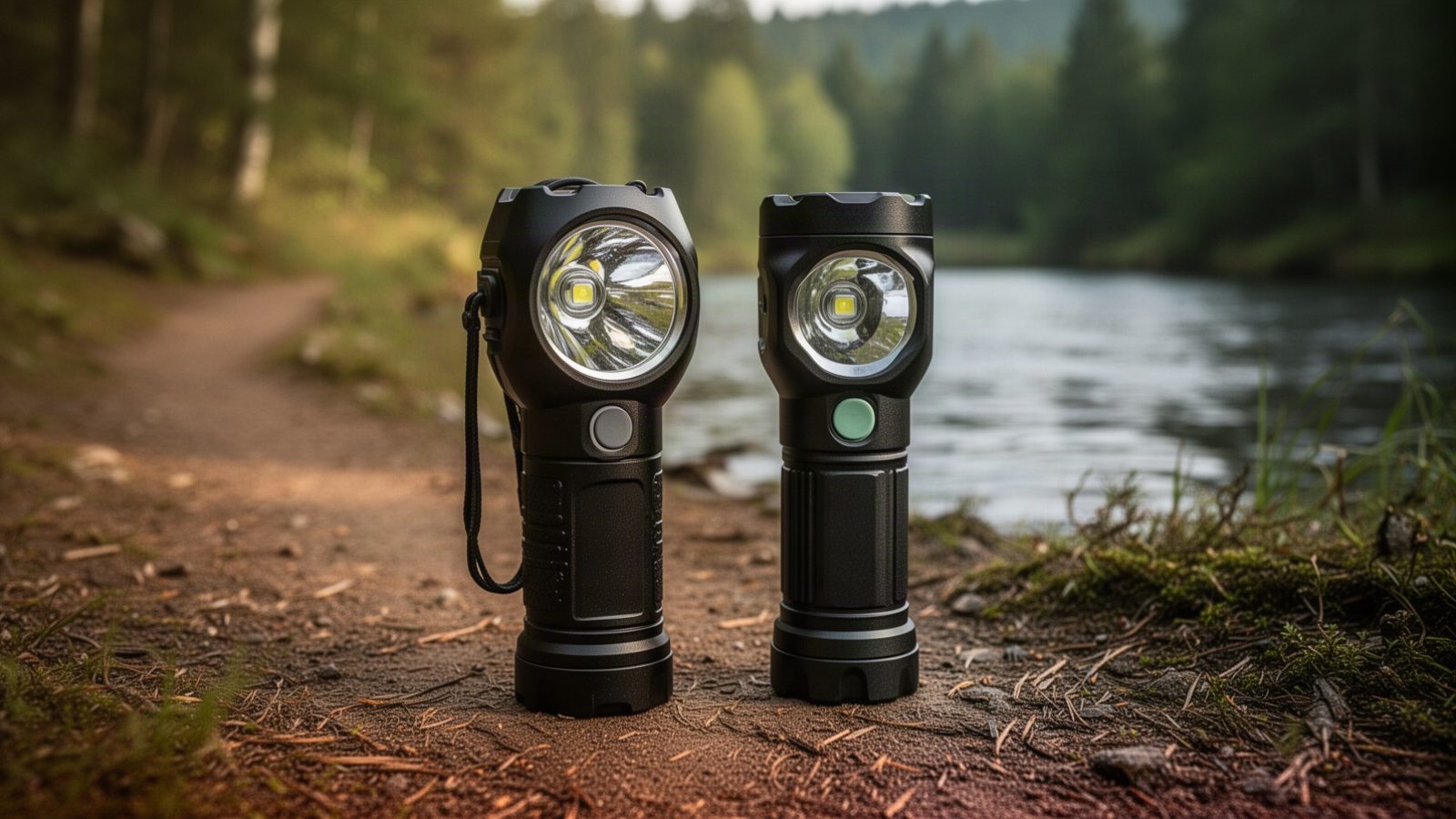
Five camping flashlights compared — compact rechargeable lights, a long-throw Fenix for searching the dark, a simple AA light and a pocket-clip penlight.
As an Amazon Associate I earn from qualifying purchases. When you buy through links on this page, we may earn a commission at no extra cost to you. Learn more
Headlamps get most of the attention, but a good flashlight is still worth a place in every camping kit. It is easier to hand to a child, better for pointing at something specific, and the most powerful models throw a beam far beyond what a headlamp can reach — useful for checking a noise at the edge of camp, scanning a lake shore or finding a trail marker.
Modern LED flashlights range from tiny pocket lights to palm-size torches with thousands of lumens. The right one depends on how bright you need it, what batteries you want to deal with and how much you will carry it. We compared popular, long-running flashlights from Olight, Fenix, Anker and Streamlight and matched each to a different camping role, from everyday carry to the emergency kit in your car.
Our top picks
-
1
 Illustration
Best overall
Olight Baton 3 Rechargeable Flashlight
Campers who want a bright light that fits in any pocket
Max output1,200 lumensBatteryRechargeable 16340-size Li-ionChargingMagnetic USB cable -
2
 Illustration
Brightest
Fenix PD36R Pro Rechargeable Flashlight
Scanning far into the dark and long trips
Max output2,800 lumensBattery21700 Li-ion (included)ChargingUSB-C -
3
 Illustration
Best value rechargeable
Anker Bolder LC90 Rechargeable Flashlight
Families who want an affordable, bright rechargeable light
Max output900 lumensBattery18650 Li-ion (included)ChargingUSB -
4
 Illustration
Best AA-powered
Fenix E20 V2.0 AA Flashlight
Emergency kits and campers who prefer standard batteries
Max output350 lumensBattery2 × AAChargingNone (uses AA batteries) -
5
 Illustration
Best pocket light
Streamlight MicroStream USB Penlight
Everyday carry and backup light
Max output250 lumensBatteryBuilt-in Li-ionChargingUSB
Olight Baton 3 Rechargeable Flashlight
Illustration
A palm-size 1,200-lumen flashlight with magnetic charging and a magnetic tail for hands-free use.
Best for: Campers who want a bright light that fits in any pocket- Max output
- 1,200 lumens
- Battery
- Rechargeable 16340-size Li-ion
- Charging
- Magnetic USB cable
- Size
- Palm-size
What we like
- Very small for its output
- Magnetic tail sticks to car doors and metal surfaces
- Simple magnetic charging
- Low modes for camp tasks
Keep in mind
- Small battery limits runtime on high
- Proprietary charging cable is easy to lose
- Maximum output steps down quickly
The Baton 3 packs a surprising amount of light into a body small enough to disappear in a pocket. Olight rates it at up to 1,200 lumens for short bursts, with lower modes for camp chores and a very dim setting for moving around without wrecking your night vision.
Two magnetic features make it especially handy at camp. The tail cap is magnetic, so you can stick it to a car door, a stove or a metal table leg and point it where you need light. Charging uses a magnetic USB cable that snaps onto the tail.
The trade-off for its size is a small battery, so runtime on high is limited and maximum output drops quickly. Keep track of the proprietary cable.
Bottom line: The best all-round camping flashlight for anyone who values a compact, bright light.
Fenix PD36R Pro Rechargeable Flashlight
Illustration
A powerful 2,800-lumen light with a large 21700 battery and USB-C charging.
Best for: Scanning far into the dark and long trips- Max output
- 2,800 lumens
- Battery
- 21700 Li-ion (included)
- Charging
- USB-C
- Size
- Hand-size tactical style
What we like
- Huge output for checking distant noises or terrain
- Large battery delivers long runtime at medium settings
- USB-C charging built in
- Rugged aluminum body
Keep in mind
- Heavier and larger than pocket lights
- Turbo is overkill for most camp tasks
- Premium-priced
When you need to see far, the PD36R Pro delivers. Fenix rates it at up to 2,800 lumens, enough to light up the far side of a meadow or a long stretch of shoreline, and its 21700 lithium-ion battery gives it long runtimes on the medium settings you will use most.
It charges over USB-C, so it shares a cable with your phone, and the tough aluminum body is built for knocks. A spare 21700 cell turns it into a light for multi-day trips without a power source.
It is bigger and heavier than a pocket light, and its turbo mode is far more than you need for cooking or reading. Think of it as the campsite’s powerful spotlight rather than everyone’s personal light.
Bottom line: The pick for maximum reach and runtime when brightness really matters.
Anker Bolder LC90 Rechargeable Flashlight
Illustration
An affordable 900-lumen rechargeable flashlight with a zoomable beam and an included 18650 battery.
Best for: Families who want an affordable, bright rechargeable light- Max output
- 900 lumens
- Battery
- 18650 Li-ion (included)
- Charging
- USB
- Beam
- Zoomable, flood to spot
What we like
- Bright output at a budget-friendly price
- Zoom head switches between flood and spot
- Included rechargeable battery
- Water-resistant build
Keep in mind
- Zoom head can let in dirt over time
- Larger than the Olight
- Fewer low-light modes than enthusiast brands
The Bolder LC90 is a long-running choice for people who want a bright rechargeable flashlight without paying enthusiast-brand prices. Anker rates it at 900 lumens, and it comes with an 18650 lithium-ion battery that charges inside the light over USB.
Its zoom head is the main selling point for campers. Slide it one way for a wide flood to light up a campsite, and the other for a focused spot that reaches farther down a trail. The water-resistant body handles rain.
The zoom mechanism is a potential entry point for dirt and moisture over time, and it is larger than premium compact lights. As a family flashlight for the car and campsite, it is good value.
Bottom line: A budget-friendly, bright rechargeable flashlight with a useful zoom beam.
Fenix E20 V2.0 AA Flashlight
Illustration
A simple 350-lumen flashlight that runs on two AA batteries available almost anywhere.
Best for: Emergency kits and campers who prefer standard batteries- Max output
- 350 lumens
- Battery
- 2 × AA
- Charging
- None (uses AA batteries)
- Body
- Aluminum alloy
What we like
- Runs on easy-to-find AA batteries
- Works with rechargeable AA cells
- Simple to use for kids and guests
- Good choice for emergency kits
Keep in mind
- Less bright than lithium-ion lights
- No built-in charging
- Disposable batteries add ongoing cost
Not every flashlight needs a lithium-ion battery and a charging cable. The Fenix E20 V2.0 runs on two AA batteries, which you can buy at any gas station, store for years in an emergency kit, or replace with rechargeable AA cells if you prefer.
Fenix rates it at 350 lumens, plenty for camp chores and walking to the restroom, and its simple controls make it easy to hand to children or guests without explanation.
It is not as bright or as long-running as lights with large lithium-ion cells, and it has no built-in charging. For a glovebox, a tent pocket or a home emergency kit, that simplicity is the point.
Bottom line: A dependable, no-fuss AA flashlight for emergency kits and family camping.
Streamlight MicroStream USB Penlight
Illustration
A slim, rechargeable 250-lumen penlight with a clip that also fits a cap brim.
Best for: Everyday carry and backup light- Max output
- 250 lumens
- Battery
- Built-in Li-ion
- Charging
- USB
- Size
- Pen-size with pocket clip
What we like
- Slim enough to clip in a shirt pocket
- Clip can attach to a cap brim for hands-free light
- Rechargeable over USB
- Tough, simple design
Keep in mind
- Built-in battery cannot be swapped
- Modest runtime on high
- Not bright enough for long-distance searching
The MicroStream USB is a slim penlight that you will actually carry. It clips to a pocket or the side of a pack, and the clip can also attach to the brim of a baseball cap, turning it into a makeshift hands-free light.
Streamlight rates it at 250 lumens, plenty for reading a map, searching a tent or walking around camp, and the built-in battery charges over USB.
It is not a searchlight, and the sealed battery cannot be replaced in the field, so runtime on high is limited. As a backup to a headlamp or a light you keep with your keys and phone, it is excellent.
Bottom line: A handy, pocket-friendly backup light that earns its place in any camping kit.
Side-by-side comparison
| Product | Max output | Battery | Charging | Size | Score |
|---|---|---|---|---|---|
| Olight Baton 3 Rechargeable FlashlightBest overall | 1,200 lumens | Rechargeable 16340-size Li-ion | Magnetic USB cable | Palm-size | 9.2 |
| Fenix PD36R Pro Rechargeable FlashlightBrightest | 2,800 lumens | 21700 Li-ion (included) | USB-C | Hand-size tactical style | 9.0 |
| Anker Bolder LC90 Rechargeable FlashlightBest value rechargeable | 900 lumens | 18650 Li-ion (included) | USB | — | 8.6 |
| Fenix E20 V2.0 AA FlashlightBest AA-powered | 350 lumens | 2 × AA | None (uses AA batteries) | — | 8.4 |
| Streamlight MicroStream USB PenlightBest pocket light | 250 lumens | Built-in Li-ion | USB | Pen-size with pocket clip | 8.2 |
Specifications are from manufacturer listings at the time of writing and can change between production runs.
Flashlight or headlamp?
Most campers should carry a headlamp for hands-free tasks and add a flashlight for reach and convenience. A flashlight is better for pointing out wildlife or trail markers, for searching under car seats and inside tents, and for handing to someone else without taking off your own light. In an emergency kit, a flashlight with standard batteries is a dependable backup.
Lumens, beam and throw
Lumens measure total light output, but beam shape decides how the light is used. A flood beam spreads light widely for walking and camp chores; a throw or spot beam concentrates it to reach far into the distance. Very high lumen figures usually last only a short time before the light steps down to manage heat, so check runtime at the medium setting you will use most.
Choosing a battery type
- AA batteries are available everywhere and store well, which makes AA lights ideal for emergency kits. Rechargeable AA cells work too.
- 18650 and 21700 lithium-ion cells pack far more energy for bright, long-running lights, and you can carry a charged spare.
- Built-in batteries keep small lights sealed and simple but cannot be swapped when they run out.
Whatever you choose, try to standardize on one or two battery types across your headlamp, flashlight and lantern, so the spares you pack fit more than one light.
Features worth paying for
- USB charging built into the light, so you need only a cable and a power bank.
- A very low "moonlight" mode that preserves night vision and runs for a long time.
- A lockout to stop accidental activation in a bag.
- A pocket clip or magnetic tail for hands-free use.
- Water resistance for rain and accidental drops in a stream.
- A switch you can find by feel in the dark, ideally one that turns on in a low mode first.
Safety and care
Never shine a bright flashlight into anyone’s eyes, and remember that high-output lights can get hot at maximum power. Carry spare lithium-ion cells in a protective case so the terminals cannot short against keys or coins. Remove disposable batteries from lights stored for long periods to avoid leaks and corrosion, charge rechargeable lights every few months, and follow the manufacturer’s charging and battery instructions.
Frequently asked questions
How many lumens does a camping flashlight need?
Around 200 to 400 lumens covers most camp tasks and walking at night. Higher outputs are useful for scanning far into the dark, but they drain batteries quickly and are rarely needed for long.
Are AA or rechargeable flashlights better for camping?
Rechargeable lights with lithium-ion cells are brighter and cheaper to run if you camp often. AA lights are easier to keep ready in emergency kits and can use batteries bought almost anywhere.
What does IPX8 mean on a flashlight?
IPX8 means the light is protected against continuous immersion in water under conditions set by the manufacturer. IPX4 means it resists splashes and rain.
Can I take lithium-ion flashlight batteries on a plane?
Spare lithium-ion batteries generally must go in carry-on bags, not checked luggage, with terminals protected. Check current airline and TSA rules before you fly.
Why does my flashlight get dimmer after a minute on turbo?
Many high-output flashlights deliberately step down their brightness to control heat and protect the battery. This is normal and is usually described in the manufacturer’s specifications.
How we picked
We compared manufacturer specifications for maximum output, battery type, charging, size, beam design and water resistance for flashlights that have been widely available online for several seasons, and weighed how each suits campsite use, night walks and emergency kits. Our picks and scores are based on this research — we have not tested these products hands-on. Brands cannot pay to be included. Read our full method.